
Your team built battlecards last quarter. Yet, somehow, there’s a rep on a call right now, losing to the same competitor for the fourth time this month and has not opened any of it.
That gap is the whole problem. Competitive battlecards rarely fail on research. The content is usually accurate and someone worked really hard on it.
So why do they fail? They fail because they're written for the person who made them, not the rep who has about eleven seconds to find the right answer while a prospect is still talking.
What is a competitive battlecard?
A competitive battlecard is a short internal reference that tells a sales rep how to handle a named competitor: where you win, where you lose, what the buyer is likely to say, and what to say back. Product marketing builds it, sales uses it live, and it gets updated on a fixed schedule. A usable card fits on one screen and is written in language a rep can say out loud without rewriting it first.
That last sentence is the part most teams skip, and it’s the reason so many cards sit unopened.
Why do competitive battlecards go unused?
Battlecards get ignored for four reasons, and none of them are about effort or research quality.
They are organized by competitor instead of by moment. A rep does not think "tell me about Competitor X." A rep thinks "they just said X is cheaper and I have four seconds."
They are too long to use live. A three page card is a research document. It is useful for onboarding and useless on a call.
The language is written to be defensible. Legal and product both reviewed it, so every claim now has a qualifier attached and no rep will say it out loud.
They go stale in public. A competitor ships a feature, the card still says they lack it, a rep gets corrected by a prospect once, and that rep never trusts the card again.
The fourth one is the quiet killer. Trust in enablement content is lost in a single embarrassing moment and it takes months to earn back. This is the same failure mode we see with messaging your sales team will actually use: the document is correct, the words are unusable, and everyone quietly reverts to improvising.
What should a competitive battlecard include?
Build the card around the five moments where a competitor actually comes up in a deal, not around a feature grid. We call this the Five Moments structure, and it’s the single change that moves a card from reference material to something reps open.
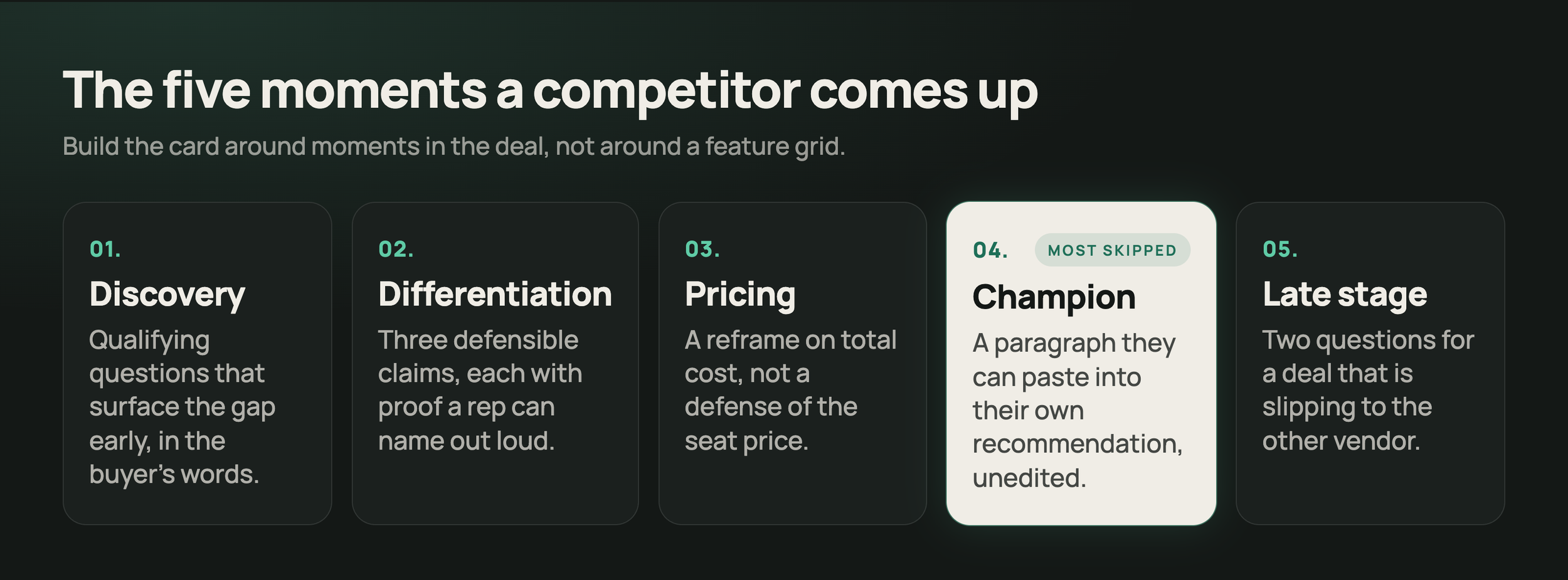
1. Discovery
What the buyer says or does: Mentions they are "also looking at" the competitor.
What the card gives the rep: Two qualifying questions that surface the need where you win.
2. The bake-off
What the buyer says or does: Builds a side by side comparison, often in a spreadsheet.
What the card gives the rep: Three claims you can defend under scrutiny, with proof.
3. The pricing squeeze
What the buyer says or does: "They quoted us 30 percent less."
What the card gives the rep: One reframe on cost, one on total cost, and your walk-away line.
4. The champion's internal sell
What the buyer says or does: Has to defend the choice to a committee.
What the card gives the rep: A short paragraph the champion can paste into their own deck.
5. The save
What the buyer says or does: Deal is going sideways late.
What the card gives the rep: Two questions that reopen the requirement, and when to stop.
The fourth moment is the one almost nobody builds, and it’s usually the highest return. Your champion is selling for you in a room you are not in, using words you did not write. Giving them a paragraph they can paste without editing is worth more than another feature comparison. If you already publish a product two pager, that paragraph is often sitting there and just needs shortening.
Here’s what that paragraph looks like when it works. It’s written for your champion to paste into their own recommendation, so it’s in their voice, not yours:
"Both tools cover the core requirement. The difference is what happens in month four. With [your company] the reporting our finance team asked for is built in, so we’re not adding a data project on top of this one. With [competitor] we would need to export and combine sources manually, which lands on our team. The license is about 20 percent higher. The implementation quote is lower by roughly the same amount."
Notice what’s not in it: superlatives, your tagline, and any claim the champion would have to defend under questioning. It reads like a person weighing a decision, because that’s exactly the room it gets used in.
What does a sterile battlecard look like next to a usable one?
The difference is almost always specificity and voice, not accuracy. Both columns below are true. Only one of them survives a live call.
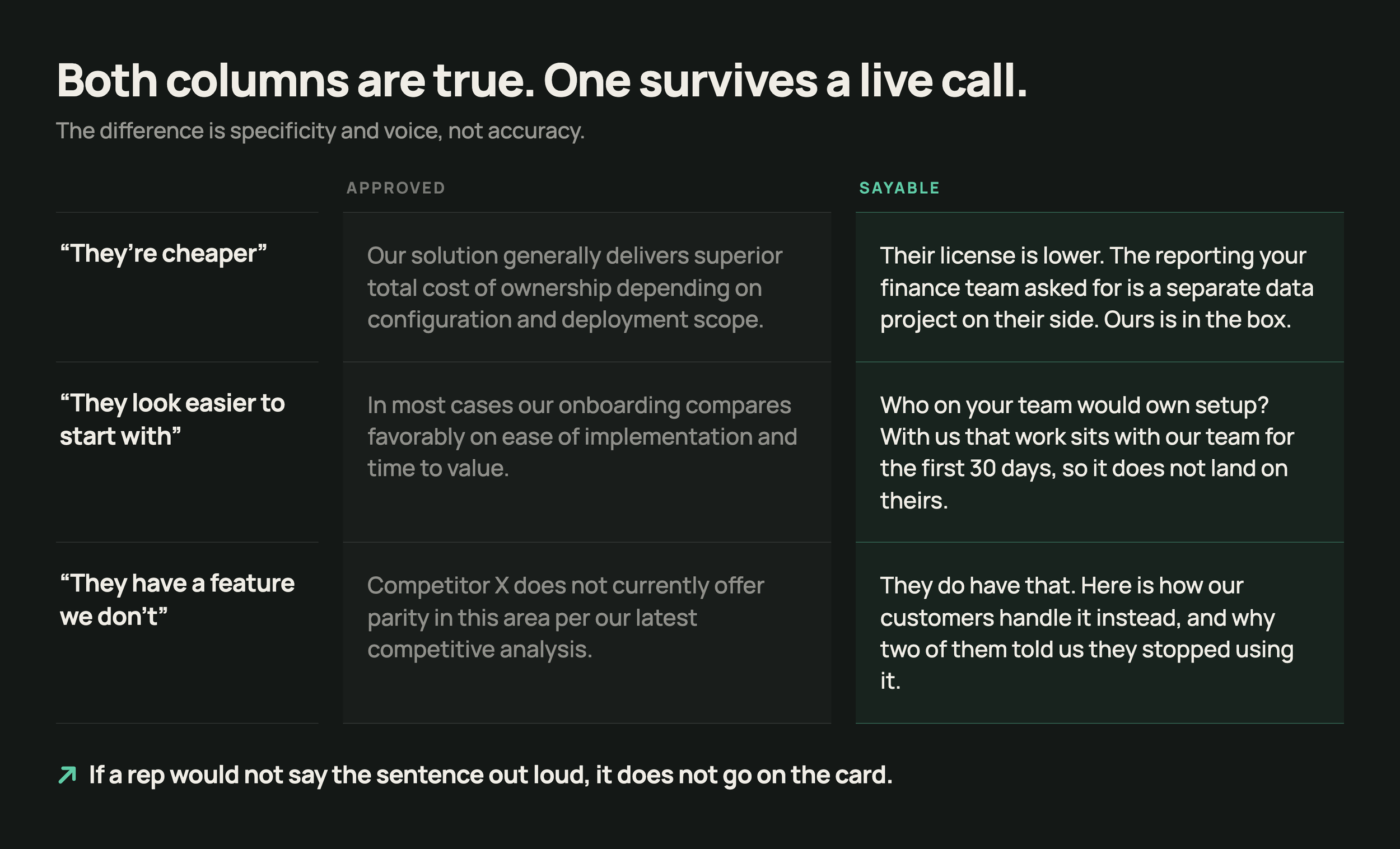
Sterile: "Our platform offers superior scalability for enterprise deployments."
What a rep will say: "Ask how many of their customers are running more than 500 seats. Ours is about a third of the base. Theirs is a handful."
Sterile: "Competitor X has limited reporting functionality."
What a rep will say: "Their reporting is fine until you need to combine two data sources. That’s where their customers end up exporting to a spreadsheet every Monday."
Sterile: "We provide industry-leading customer support."
What a rep will say: "You get a named person, not a queue. Ask them what happens when you file a ticket on a Friday."
Sterile: "Pricing is competitive and reflects the value delivered."
What a rep will say: "We are usually 20 percent higher on the license. Ask what they charge for implementation, because that is where the gap closes."
Read the second line in each pair out loud. It sounds like a person who has been on a hundred of these calls. The first line sounds like it was approved.
The rule we use: if a rep would not say the sentence out loud on a call, it does not go on the card. No exceptions for lines that leadership likes.
What should you leave off a competitive battlecard?
Cut anything that serves an internal audience rather than the rep on call.
The competitor's full feature list. It ages fastest, it’s the thing prospects correct you on, and no rep reads a grid mid-sentence.
Funding rounds, headcount, and org charts. Interesting in a strategy review. Useless when someone just asked why you cost more.
Long disclaimers. If a claim needs three sentences of protection, it’s not a claim you can make on a call. Find a different one.
Anything you would not want screenshotted. Assume every internal card eventually reaches a competitor, because it does. Write nothing you would be embarrassed to defend.
A card gets shorter as it gets better. If your second version is longer than your first, you added research instead of making a decision.
How do you write objection lines reps will say out loud?
Write them from recordings, not from a competitor's website. The words your buyers use are already in your call library, and they are better than anything you will compose in a doc.
Pull five recent calls where the competitor came up. Losses first. Losses are more honest.
Write down the buyer's exact phrasing. Not the summary. The phrasing. "It looked like less of a lift for my team" is the objection. "Ease of implementation" is a category.
Write down what your best rep actually said back. Steal it. That rep already solved this and nobody wrote it down.
Cut every qualifier that survived review. "Generally," "in most cases," and "depending on configuration" are how a true sentence becomes an unsayable one.
Test it in one role play before it ships. If the rep pauses to translate it, rewrite it.
The research is already done. It’s sitting in your call recordings, and the reason nobody has used it is that listening to five calls feels less productive than writing a new document.
Watch for the objection that’s not really about your product. A buyer who says "they seem easier to get started with" is usually telling you they are worried about their own team's bandwidth, not comparing setup wizards. The line that answers that’s about what your onboarding takes off their plate, not about your setup wizard being faster. Cards that answer the literal objection instead of the real one are technically correct and lose deals anyway.
Where should competitive battlecards live?
Put the card where the rep already has a window open during a call, and nowhere else.
The most common distribution mistake is treating the wiki as the destination. A rep on a live call is not going to open a second tab, search, scan a results page, and pick the right document. They will guess instead, and their guess will be worse than your card. Findability is not a nice-to-have on top of good content. It is the thing that decides whether good content gets used at all.
In practice that means one canonical card per competitor, surfaced in the CRM or the enablement tool the rep is already in, with the competitor's name as the first word of the title. Every other copy is a link back to that one. The moment there are two versions of a card, reps stop trusting both, and you now have a maintenance problem that grows with every quarter.
Say it in the sales meeting too. A card announced once in a Slack channel does not exist. A card walked through in a role play, then referenced by a manager in the next pipeline review, becomes part of how the team sells. Our 7 steps to start your SaaS sales process covers where this fits in a repeatable motion.
How do you keep competitive battlecards current?
Set a review cadence tied to the competitor's release rhythm, and put a visible date on the card so reps can judge it themselves.
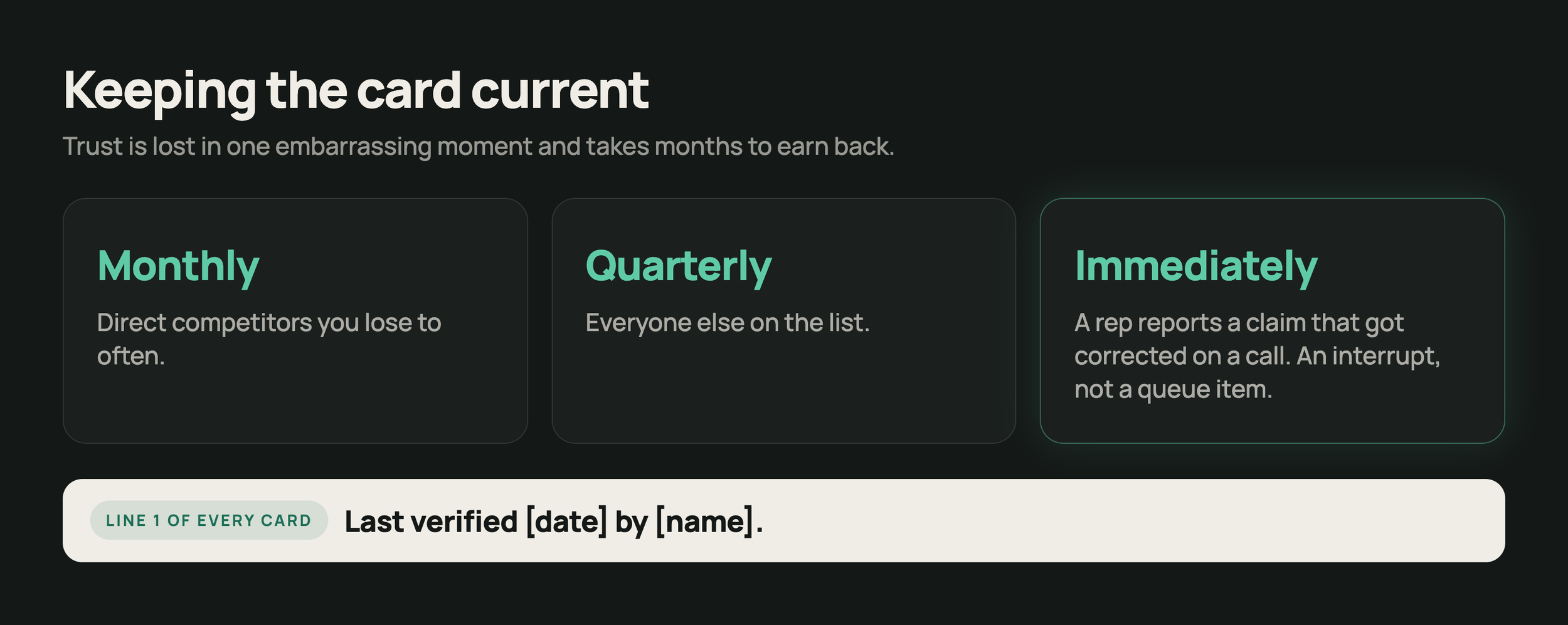
Monthly for a direct competitor you lose to often.
Quarterly for everyone else.
Immediately when a rep reports a claim that got corrected on a call. This is an interrupt, not a queue item.
Add one line at the top of every card: "Last verified [date] by [name]." It costs nothing and it’s the difference between a rep trusting the card and a rep guessing at its age. When a card passes its review date, mark it stale rather than deleting it. Reps will use a card labeled stale. They will not use a card that disappeared.
One more practice worth stealing: give every card an owner by name, not by team. Cards owned by "product marketing" are owned by nobody.
How do you know your competitive battlecards are working?
Use the Last Deal Test. Pull your last five losses to a single competitor and read the card as if you were the rep on each of those calls. For each loss, ask one question: was the sentence that would have changed this conversation on the card?
If the answer is no on three or more, the card is documentation, not enablement. Rebuild it from those five calls.
Run the test with a rep in the room, not alone at your desk. Product marketers grade their own cards generously, because we know what the card meant. The rep knows what the card said. When those two answers differ, the rep is right.
Track two things after that:
Open rate in the first 30 days. Most enablement tools report this. If reps are not opening a new card in the first month, the problem is findability or length, not content.
Competitive win rate against that one competitor. Compare the two quarters on either side of the rebuild. It’s a slow signal and it moves for many reasons, so treat it as directional rather than proof.
Both beat the metric most teams use, which is whether the card exists. For a fuller view of what to measure and what to ignore, our guide to choosing the right product marketing metrics covers the trade-offs.
Start with one competitor and one page
The teams with battlecards reps actually open did not build a library. They built one card, for the competitor that shows up in the most deals, from five real call recordings, and they put a date on it. Then, they built the second one.
A card that fits on one screen and sounds like a person beats a complete competitive intelligence program that nobody opens. Pick the competitor you lost to last week and write the five moments for that one deal.
Olivine builds competitive battlecards and the sales enablement training that gets reps using them, as part of our work with B2B SaaS teams.
Frequently asked questions about competitive battlecards
What is a competitive battlecard?
A competitive battlecard is a one screen internal reference that tells a sales rep how to handle one named competitor. It covers where you win, where you lose, the objections buyers raise, and the exact language to respond with. Product marketing owns it, sales uses it live on calls, and it carries a visible last-verified date.
What should a competitive battlecard include?
Include five things: qualifying questions for discovery, three defensible differentiation claims with proof, a pricing reframe, a short paragraph your champion can paste into their internal deck, and two questions for saving a late-stage deal. Skip the full feature grid. It does not get read during a live conversation.
Who owns competitive battlecards, product marketing or sales enablement?
Product marketing owns the content and the competitive research. Sales enablement owns distribution, training, and adoption. One named person should own each individual card, because cards assigned to a team rather than a person go stale. Sales leadership owns the feedback loop that reports incorrect claims quickly.
How often should you update competitive battlecards?
Update monthly for competitors you face often, and quarterly for the rest. Update immediately when a rep reports that a claim was corrected on a call, because a single wrong claim costs you that rep's trust in every card. Put the last-verified date at the top so reps can judge the card themselves.
What is the difference between a battlecard and a sales one pager?
A battlecard is internal and reactive. It tells your rep what to say when a specific competitor comes up. A one pager or two pager is external and proactive. You send it to the buyer to explain your product on its own terms. Different audience, different language, different job.