
ICP vs. Buyer Persona: What Each One Is For (and When You Need Both)
An ideal customer profile (ICP) describes the type of company worth selling to. A buyer persona describes the person inside that company you have to convince. The ICP decides where your team spends its time, and the persona decides what your team says once it gets in the room. Usually, B2B SaaS companies need both, and they fail in different ways when a team builds only one.
Most of the teams we work with already have both documents somewhere. The persona deck has a stock photo and a name like Marketing Mary, and nobody in sales has opened it since the day it was presented. The ICP says something like "mid-market B2B SaaS companies that value data-driven decision making," which no SDR can build a list from, so they build their own from whoever replies to outbound. Both took weeks to produce, and neither one changes what anyone does on Monday.
In our experience, that's more of a definition problem, rather than a rarely a research problem. The team built one asset when the job needed two, then blurred the line between them until neither did its work.
This guide covers what each one is, how they actually differ, how to build both from data you already have, and how to tell which one is causing the problem you're seeing right now.
What Is an Ideal Customer Profile (ICP)?
An ideal customer profile is a description of the type of company worth selling to. It covers firmographics like employee count, industry, and geography, technographics like the software they already run, and situational signals like funding stage, headcount growth, or a recent leadership hire.
The ICP is an account-level filter, and it answers one question: should we spend time on this company at all. Demand gen uses it to build audiences, SDRs use it to qualify, and any account-based program starts here.
A working ICP reads as criteria someone can filter a list with. If your SDR can't open a sales database, apply the profile, and come back with named accounts, what you've written is a description rather than an ICP.
What Does an ICP Include?
A working ICP pulls from four categories. The first two describe what a company is, and the last two describe what's happening inside it, which is usually where the buying signal sits.
1. Firmographics. Employee count, revenue or funding stage, industry, geography, and company structure. These are the easiest to source and the easiest to over-rely on, since plenty of companies share a shape and behave nothing alike.
2. Technographics. What they already run, what they recently bought, and what they've built in-house. A company running two CRMs has a problem a company running one doesn't.
3. Situational signals. A funding round, a new executive, a compliance deadline, a migration, a merger. These explain timing, and timing is usually what separates a deal from a polite no.
4. Account health signals. For companies already in your funnel or your customer base: usage depth, seat expansion, support load, renewal history. This is where you learn which of your customers you should have said no to.
How Do ICP, TAM, SAM, and SOM Relate?
These four get used interchangeably in board decks and they sit at different altitudes.
What Is a Buyer Persona?
A buyer persona is a description of a person inside those companies. It covers their role and what their boss measures them on, the job they're trying to get done this quarter, the words they use for the problem, who they have to convince internally, and what makes them say no.
The persona answers a different question: what do we say to this human. It shapes messaging, campaign copy, sales talk tracks, and enablement material. Olivine's earlier guide to what a buyer persona is goes deeper on the research side.
Is a User Persona the Same as a Buyer Persona?
No, and in B2B this particular mix-up is an expensive one. A user persona describes the person working in the product every day, which is what your product and design teams need. A buyer persona describes the person who signs, approves, or champions the purchase.
In plenty of B2B SaaS categories those are different people with opposite priorities. The user wants fewer clicks. The buyer wants a number they can report upward. Copy written for the user and aimed at the buyer is one of the quieter reasons pipeline stalls.
Product-led companies have the reverse problem. The user is the entry point and the buyer shows up later, which means you need both and you need to know which one any given page is talking to.
Who Sits in a B2B Buying Committee?
Past a certain price, B2B SaaS purchases involve several people, and each one needs a different argument. You don't need a persona for every seat, but you do need to know which seat kills your deals.
Profile the champion first, since they do the selling in every room you're not in. Profile whichever seat blocks you most often second.
What Is the Difference Between an ICP and a Buyer Persona?
The ICP is responsible for selecting which doors to approach, the persona will then guide you on what to say when someone opens one. For better understanding, we’ve differentiated between the two below.
Teams that skip the ICP end up with beautiful messaging aimed at companies that will never buy. Teams that skip personas end up with clean target lists and outbound nobody answers.
The confusion tends to show up in one specific place. Someone writes "VP of Marketing at a 500-person SaaS company" and calls it a persona. Half of that sentence belongs in the ICP, and the half describing the person stops at a job title. A rep reading it still has no idea what that VP is trying to fix, who signs off on her budget, or what she'll say when the price comes up.
When Do You Need an ICP vs. a Buyer Persona?
Most companies need both, so the useful question is which one to fix first. The stage where your deals break tells you which document is failing.
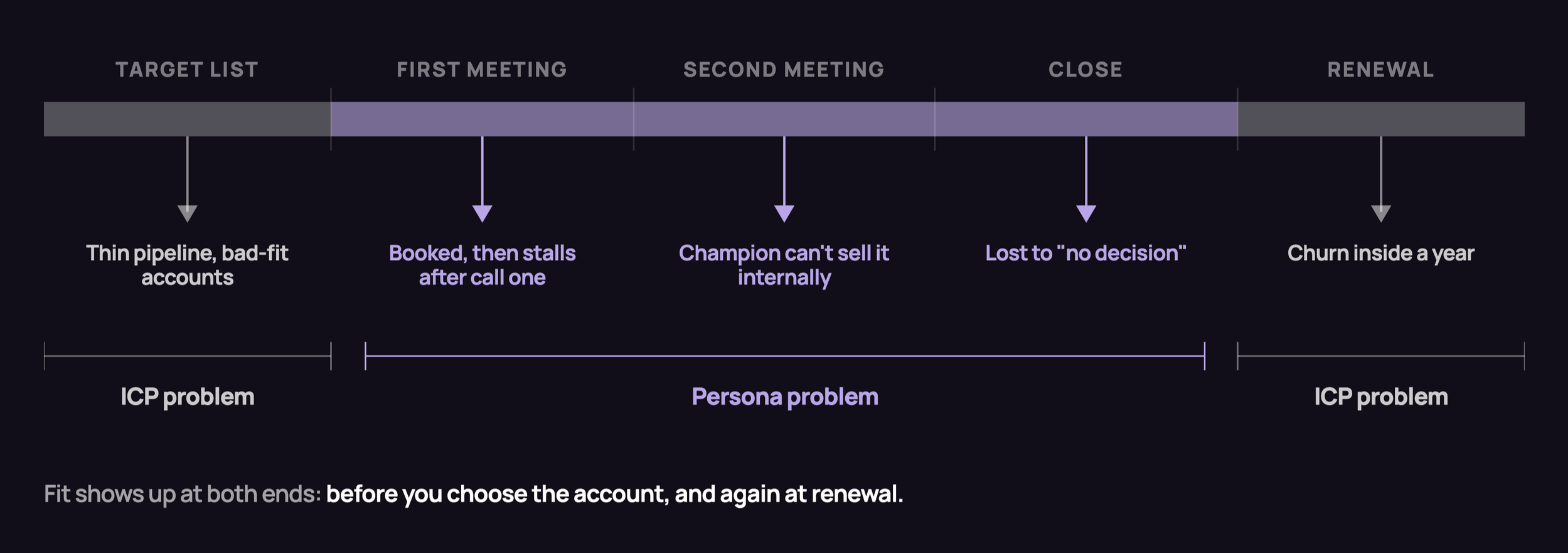
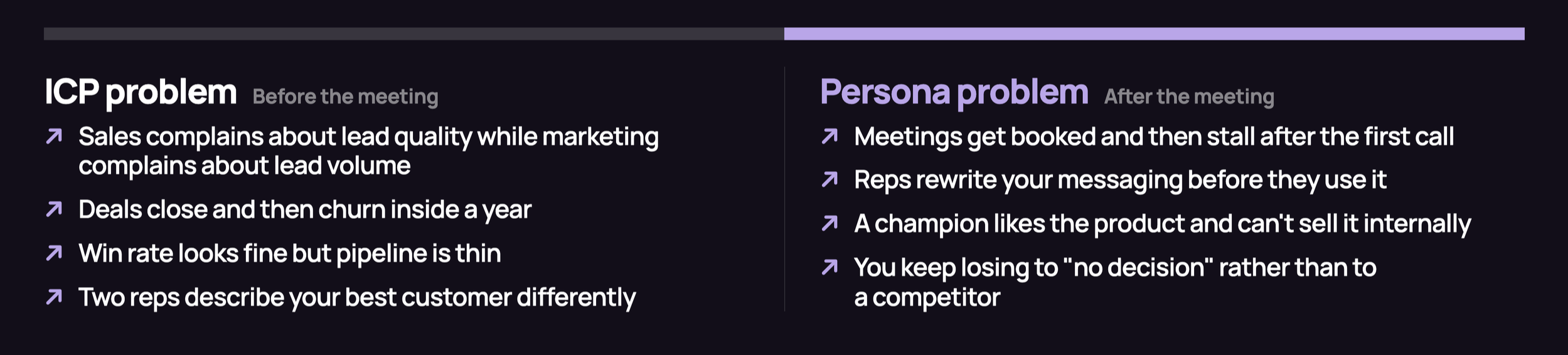
An ICP problem shows up early, while you're still choosing who to talk to, so the damage lands on pipeline volume and fit. A persona problem shows up later, once the right company is already on the call, so the damage lands on conversion and momentum inside the deal.
Your ICP is the problem when:
Sales complains about lead quality while marketing complains about lead volume. Both teams are describing the same thing from opposite ends, and neither can point to a shared definition of a good account.
Deals close and then churn inside a year. A customer who leaves before the second renewal usually shouldn't have been sold to in the first place, and that's a targeting decision rather than a customer success failure.
Your win rate looks fine but your pipeline is thin. When you win the deals you get into and still miss the number, the problem is upstream of selling.
Two reps describe your best customer differently. If there's no shared answer, every rep is working from a private ICP they built themselves.
Your buyer persona is the problem when:
Meetings get booked and then stall after the first call. You reached the right company and said the wrong thing to the person in it.
Reps rewrite your messaging before they use it. Sales teams are practical. When they quietly rebuild your language, they're telling you it doesn't survive contact with a real buyer.
A champion likes the product and can't sell it internally. You gave them a pitch for themselves and nothing to carry into the rooms you're not in.
You keep losing to "no decision" rather than to a competitor. Deals that die this way usually died at a seat you never wrote anything for.
If both lists look familiar, start with the ICP. Persona research has to come from buyers at companies that already fit your profile, so interviewing people outside it gives you accurate answers to the wrong question.
How Do You Build an ICP for a B2B SaaS Company?
1. Start with closed-won, not with ambition. Pull 12 to 24 months of won deals out of your CRM. An ICP is a pattern you find in your own data, not a description of the customer you wish you had.
2. Filter for good revenue, not all revenue. Keep the accounts that renewed, expanded, and didn't need heavy support. A logo you won and then lost teaches you what to exclude. If you have fewer than twenty good accounts to work from, widen the window rather than lowering the bar.
3. Look for the situation, not just the shape. Employee count and industry get you partway. The useful signal is usually circumstantial: they'd just hired their first RevOps lead, or they were running two teams on separate systems, or they had a compliance deadline nine months out. Situational triggers are what make outbound land in the month it lands.
4. Write it as filter criteria. Compare these two:
Mid-market B2B SaaS companies that value data-driven decision making.
B2B SaaS companies, 200 to 1,000 employees, Series B or later, running two or more sales teams on separate CRMs, who hired a RevOps lead in the past 12 months.
An SDR can build a list from the second one this afternoon. The first is a sentence about your brand.
5. Add the disqualifiers. Name the companies that look right on paper and behave wrong in practice, sometimes called anti-personas or negative profiles. Common ones include accounts that need a security review you can't pass yet, companies with an incumbent contract more than a year from renewal, and any segment where your last three deals all needed custom work to close. This part saves more time than the inclusion criteria do.
6. Test it against your last ten losses. If most of them fit your ICP, the profile is too loose. Tighten it and run the test again, then apply it to open pipeline to see how much of your current quarter would have been disqualified.
If you sell a horizontal product and the pattern refuses to resolve, the problem may be segmentation rather than data. Olivine's guide to defining target verticals for a horizontal SaaS product walks through that decision.
How Do You Tier Accounts Inside Your ICP?
A single pass-fail filter wastes effort at both ends, so most teams get more out of three tiers.
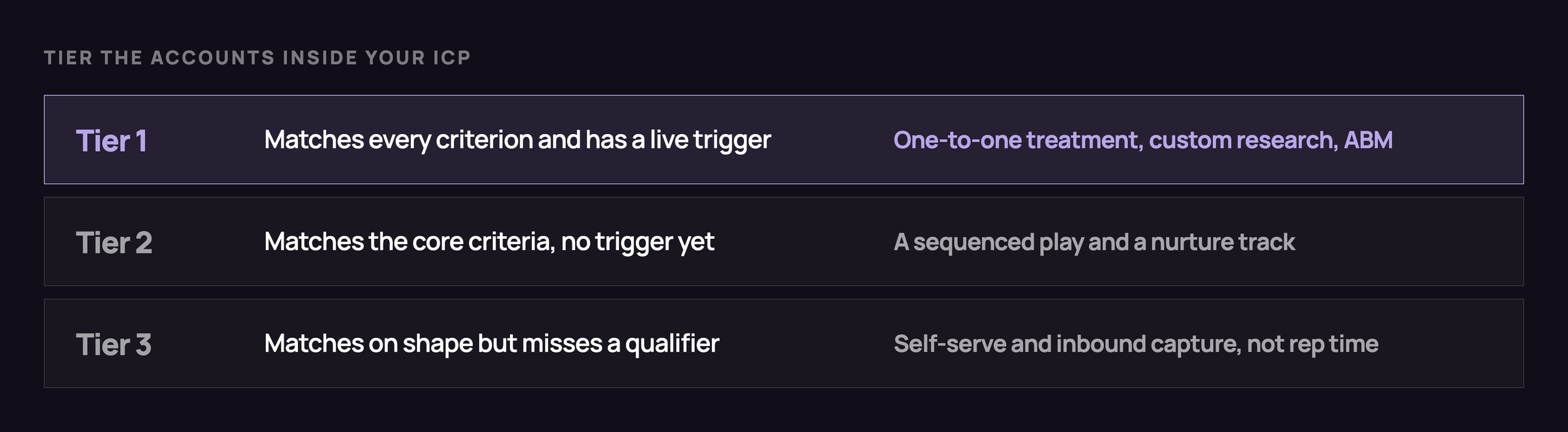
Tier 1 matches every criterion and has a live trigger. These are worth one-to-one treatment, custom research, and an ABM motion.
Tier 2 matches the core criteria without a trigger yet. These are worth a sequenced play and a nurture track until something changes.
Tier 3 matches on shape but misses a qualifier. These are worth self-serve and inbound capture rather than rep time.
Tiering also gives you a clean way to say no. A rep who wants to work an out-of-profile account has to argue for an exception instead of quietly adding it to the pipeline.
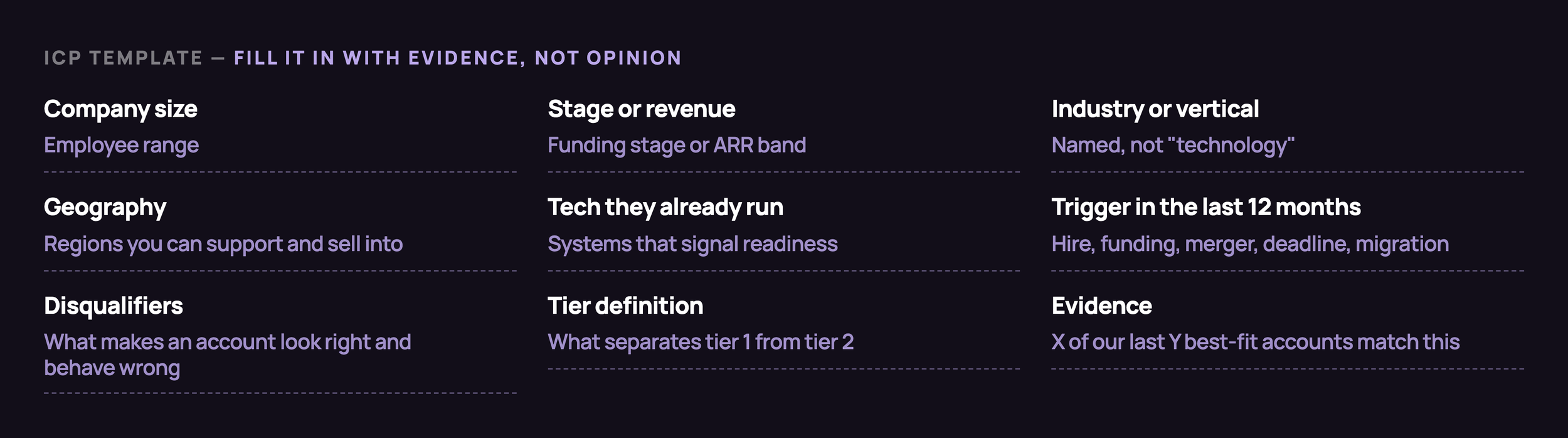
ICP Template
Copy this and fill it in with evidence rather than opinion.
Company size: [employee range]
Stage or revenue: [funding stage or ARR band]
Industry or vertical: [named, not "technology"]
Geography: [regions you can support and sell into]
Tech they already run: [systems that signal readiness]
Trigger in the last 12 months: [hire, funding, merger, deadline, migration]
Disqualifiers: [what makes an account look right and behave wrong]
Tier definition: [what separates tier 1 from tier 2]
Evidence: [X of our last Y best-fit accounts match this]
How Do You Build a Buyer Persona Your Sales Team Will Use?
1. Source it from calls, not from surveys. Pull eight to twelve recordings where the deal involved the role you're profiling, and prioritize the losses. Buyers explain themselves more honestly when they're saying no. Surveys give you what buyers think they should say, and recordings give you what they actually said under time pressure.
2. Write down their words. The phrase a buyer uses for the problem belongs in your headline. If three buyers call it "reconciliation hell" and your site calls it "financial operations complexity," your site is wrong.
3. Capture what their boss measures them on. A VP of Support cares about deflection rate this quarter. That number, not their job title, decides whether they take the meeting.
4. Capture the internal sell. Write the paragraph your champion needs to paste into their own deck. Your buyer is doing the selling in every room you're not in, and most of those rooms are where deals are actually lost.
5. Cut anything a rep can't say on a call. Age ranges, hobbies, preferred social platforms, a stock photo. None of it changes a sentence anyone says.
6. Validate with two reps before you publish. Send the draft to your best rep and your newest one. The experienced rep tells you what's wrong, and the new rep tells you what's unclear. Both are worth an hour.
The difference between a persona nobody opens and one reps keep in a tab comes down to whether the lines are usable out loud.
The test is a simple one. If a rep opens the persona mid-deal and can't find one sentence to use, what you've written is a research summary rather than a persona. Most of the raw material for this comes out of customer and market research, which is why the two projects usually run together.
What Does a B2B Buyer Persona Template Include?
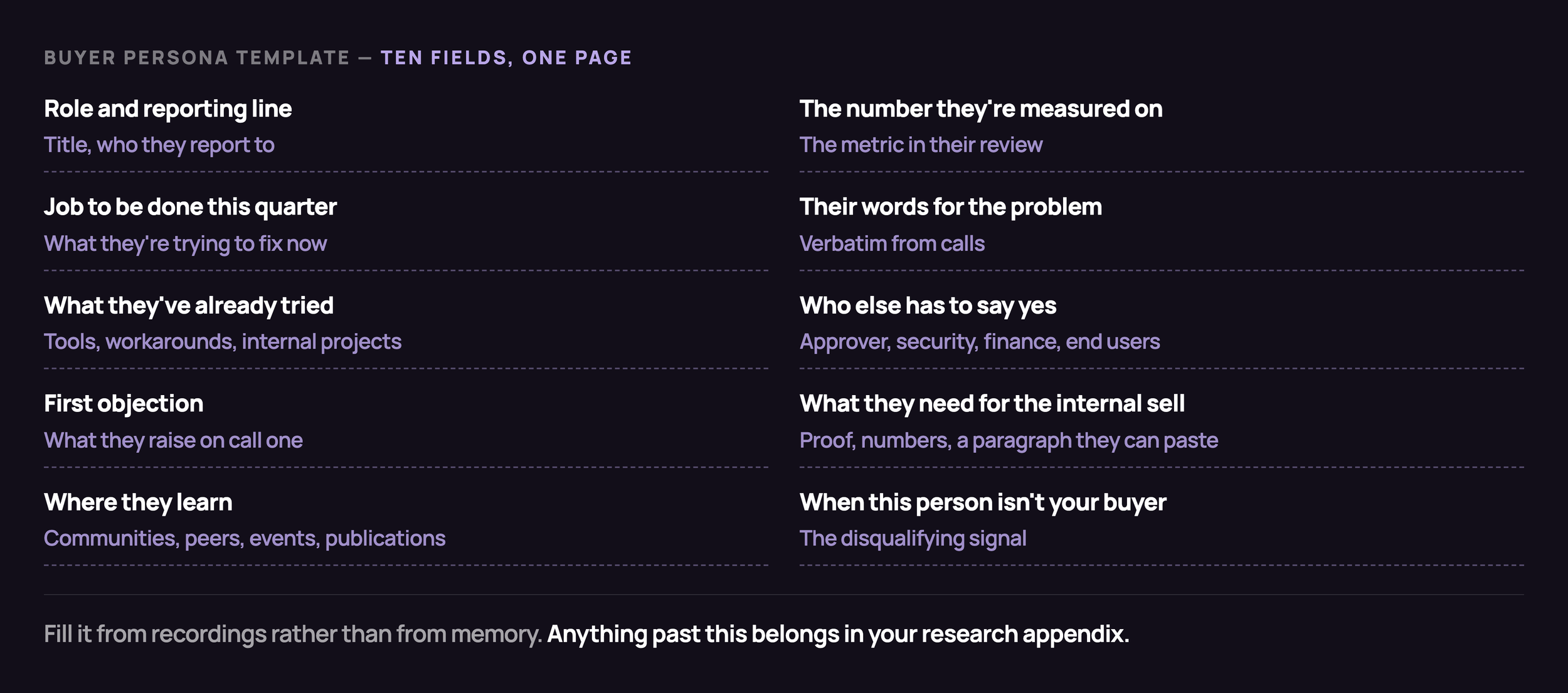
A usable B2B buyer persona template holds ten fields and fits on one page. Anything past this belongs in your research appendix.
Role and reporting line: [title, who they report to]
The number they're measured on: [the metric in their review]
Job to be done this quarter: [what they're trying to fix now]
Their words for the problem: [verbatim from calls]
What they've already tried: [tools, workarounds, internal projects]
Who else has to say yes: [approver, security, finance, end users]
First objection: [what they raise on call one]
What they need for the internal sell: [proof, numbers, a paragraph they can paste]
Where they learn: [communities, peers, events, publications]
When this person isn't your buyer: [the disqualifying signal]
Fill it from recordings rather than from memory. A persona assembled in a workshop reflects what your team believes about buyers. A persona assembled from calls reflects what buyers said.
What Does This Look Like in Practice?
Here's a hypothetical to show the level of specificity that works. Imagine a support automation platform selling to mid-market companies.
The ICP they started with: "Growing companies with customer support teams who want to scale efficiently." Any competitor could have written the same sentence, and outbound reply rates sat under one percent.
The ICP after reviewing twenty closed-won accounts: B2B SaaS and e-commerce companies, 300 to 2,000 employees, support teams of fifteen or more agents, running Zendesk or Intercom, above 8,000 tickets a month, who hired a support operations or CX lead in the past year. Disqualifiers: fewer than five agents, and regulated healthcare until the platform ships a BAA.
The second version is filterable, and it disqualifies roughly seventy percent of the list the team had been working.
The personas underneath it:
The Head of Support is the champion. She's measured on first response time and CSAT, and her words for the problem are "we're drowning on Mondays." She's already tried two contractors and a macro overhaul, and what she needs is a before-and-after number for her QBR.
The VP of Finance is the economic buyer. He cares about cost per ticket and headcount avoided, and his first objection is always migration cost rather than the license fee.
IT security is the gatekeeper. They kill deals late and they need SOC 2 and SSO detail before the second call, not after the fourth.
What changed downstream. The homepage headline moved from "Scale your support operations" to a line built around the Monday problem. Sales stopped leading with feature depth and started leading with tickets deflected per agent. Security documentation moved from the closing stage into the first follow-up email, which removed the step where deals had been dying.
None of that came out of a workshop. It came from twelve call recordings and a CRM export.
How Do You Know Your ICP and Buyer Personas Are Working?
Both are working when your numbers start separating. An ICP that describes your best customers should open a visible gap between in-profile and out-of-profile accounts, and personas built from real buyers should show up as language reps keep instead of rewrite.
Take a baseline before you publish either document, then check these at 90 days. Skip the baseline and you'll spend the next quarter arguing about whether anything changed.
For the ICP:
Win rate for in-profile accounts against out-of-profile accounts. No visible gap means your profile isn't discriminating between anything.
Percentage of new pipeline that fits the profile.
Average contract value and time to close by tier.
Net revenue retention by tier, which is the honest test, since ICP fit shows up at renewal more than at signature.
For the personas:
Whether reps use your language without rewriting it. Pull five recent calls and listen for your own phrases.
Conversion from first meeting to second, which is where persona problems surface.
Percentage of open deals with a named champion and a named economic buyer in the CRM.
Loss reasons. A drop in "no decision" losses is the clearest sign your internal-sell material is landing.
If none of these move, the documents probably aren't the problem. Adoption is, and someone has to own that, usually sales leadership rather than whoever wrote the doc.
What Goes Wrong When You Confuse Your ICP and Buyer Persona?
Personas built from firmographics. You end up describing the company inside a document about a person, and the messaging talks about "mid-market organizations" instead of the thing keeping your buyer up on Tuesday.
ICPs built from persona traits. "Forward-thinking marketing leaders" can't be filtered, targeted, or reported on, so your demand gen team quietly reverts to whatever lists they can actually build.
One persona standing in for a committee. Marketing writes to the user, sales sells to the buyer, and the person controlling the budget never hears an argument aimed at them. Deals stall at approval and the loss gets logged as "timing."
Great content aimed outside the ICP. The blog performs, demos don't convert, and someone concludes that content marketing doesn't work. The content was fine. The audience was wrong.
Nine personas and none of them used. Teams that can't choose end up documenting every job title in the account. Two to four personas per product line is the range most B2B SaaS teams can maintain and reps can remember.
Documents nobody revisits. An ICP written before you moved upmarket describes customers you no longer sell to. Put a last-updated date at the top of both where people can see it.
How Do Your ICP and Personas Feed Positioning and Messaging?
Both documents are inputs rather than outputs. The ICP tells you which market you're positioning against, since your competitive set changes entirely between a 50-person startup and a 2,000-person enterprise. The persona tells you which outcome to lead with, since the champion and the economic buyer want different sentences.
Skip either one and the messaging work turns into a writing exercise. The team ends up debating adjectives, because nobody in the room can settle an argument with evidence about who the buyer actually is.
That's why positioning and messaging projects stall when either document is missing, and why the research usually has to come first.
How Olivine Approaches ICP and Persona Development
Olivine has been assisting a B2B SaaS product marketing teams since 2016. We've built ICPs and buyer personas for companies from seed stage through public, across cybersecurity, fintech, healthcare technology, and developer tools.
We start with research rather than a workshop. That means customer interviews, call recordings, and a close look at your closed-won and closed-lost data before anyone writes a profile. Workshops come after, once there's evidence in the room to settle the disagreements that always come up.
What clients get at the end is a filterable ICP their SDRs can build lists from and personas short enough for reps to use mid-call, along with the messaging work those documents feed.
Work With Olivine on Your ICP and Personas
If your pipeline is full of companies that don't close, or your reps keep rewriting the messaging before they use it, the fix usually starts with one of these two documents rather than with more campaigns.
Visit Olivine's persona and ICP development page to see how we work, or get in touch to talk through which one is causing your problem.
Frequently Asked Questions (FAQs)
Can you have an ICP without buyer personas? Yes, and early-stage teams often should. An ideal customer profile alone lets you target accounts and test demand. You'll hit the ceiling once meetings start stalling, because targeting the right company doesn't tell your reps what to say to the people inside it.
How many buyer personas should a B2B SaaS company have? Two to four per product line. Profile the champion, the economic buyer, and the technical or security gatekeeper if one blocks your deals. Past four, reps stop remembering which is which and your personas become documentation rather than working tools.
What data do you need to build an ICP? Closed-won and closed-lost records from the past 12 to 24 months, retention and expansion data, and support volume by account. Firmographic and technographic enrichment helps you spot patterns, though the situational signals that matter most usually surface only in customer interviews.
Who owns the ICP, marketing or sales? Product marketing owns the definition and the research behind it. Sales leadership owns adoption, since an ICP only matters if reps qualify against it. Review it together on a set cadence, because a profile one team maintains alone drifts out of use within two quarters.
How often should you update your ICP? Twice a year as a baseline, and immediately when you launch a product, change pricing, move upmarket, or enter a new region. Any of those shifts changes which companies can buy from you, which turns your previous profile into a description of past customers.