
TL;DR
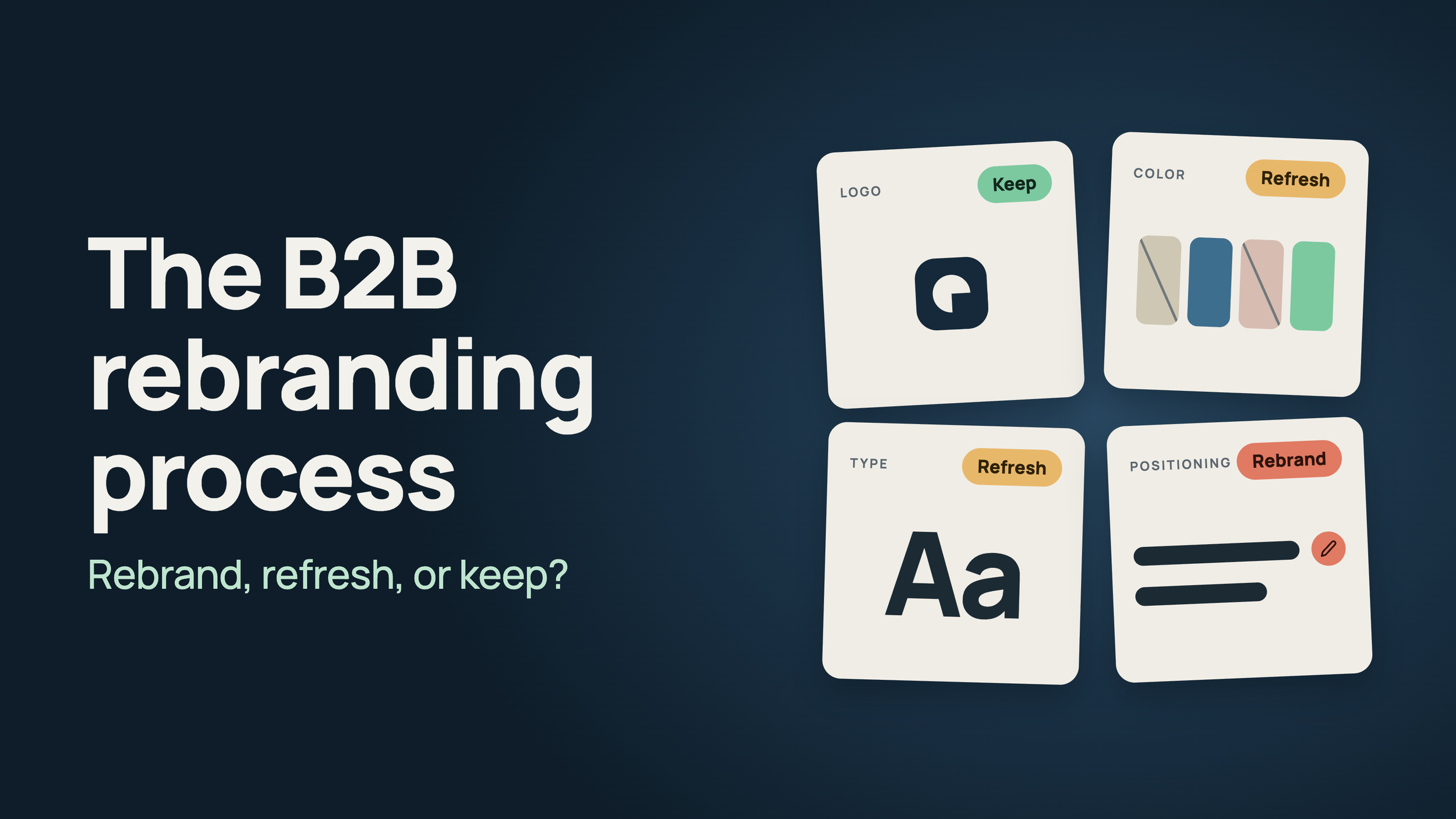
A B2B rebrand changes how a company is positioned and presented, and a brand refresh updates the look while the positioning stays put. Rebrand when the positioning has changed, after an acquisition, when you move upmarket, or when the name no longer fits. The rebranding process runs in six steps: positioning, research, messaging, identity, website and sales assets, then rollout. Before anything changes, sort every asset into keep, evolve, or replace, and protect your URLs and search rankings with redirects.
When SoSafe came to us, the security awareness platform was in the middle of a high-growth stretch. It had a $73M Series B, a new website on the way, and a brand that no longer represented the product. The old identity looked generic and clinical, a lot like the legacy security companies SoSafe wanted to stand apart from.
The first month had no logo work in it. We spent it on discovery across the brand, the product, and the go-to-market strategy, then ran workshops on personas, jobs to be done, brand and product positioning, and naming. The new logo, colors, and type came after the team agreed on its value propositions and differentiators, and the refresh then carried into a new sales deck, one-pagers, an investor deck, and 11 pages of website copy.
That order is the main lesson of this guide to B2B rebranding. A rebrand that starts with visuals hands the designer a brief nobody has agreed on, and the gaps show up later in sales calls. A rebrand that starts with positioning gives every later decision, from the name to the URL structure, something to be checked against.
Key Takeaways
- A rebrand and a refresh solve different problems: Rebrand when your positioning has changed, and refresh when the positioning holds and the look has fallen behind it.
- Four situations usually call for a rebrand: New positioning, an acquisition, a move upmarket, and a name that no longer fits.
- The rebranding process starts with positioning: Research, messaging, and identity all depend on knowing what changed and for whom.
- Audit before you change anything: Sort every brand asset into keep, evolve, or replace, so recognition and search equity survive the change.
- Roll out from the inside: Leadership, sales, and customer success get the new story before customers or the public see it.
- Redirects protect rankings: Map every old URL to its new home and keep 301 redirects in place for at least a year.
What Is a B2B Rebrand, and How Is It Different From a Brand Refresh?
A B2B rebrand is a change to how a company positions and presents itself to buyers, usually covering its positioning, messaging, visual identity, and sometimes its name. A brand refresh keeps the positioning and name, and updates the look and feel so the brand matches where the company is today. One changes what the brand stands for, and the other changes how it shows up.
Most teams can tell which one they need by answering a single question: has our positioning changed? If the company sells to the same buyers, solves the same problem, and wins for the same reasons, the work is a refresh, even if the logo looks dated. If any of those three have moved, the work is a rebrand, and the visuals are the last part of it. The brand refresh vs. rebrand comparison below shows where the two differ in practice.
| Brand refresh | Rebrand | |
|---|---|---|
| Starts with | The current visual identity | The positioning and who the company sells to |
| What changes | Logo details, colors, type, imagery, templates | Positioning, messaging, identity, and sometimes the name |
| What stays | Positioning, name, and core messaging | Whatever the keep, evolve, replace audit protects |
| Typical timeline | A few weeks to three months | Four to nine months, longer with a name change |
| Who's involved | Marketing and design | Leadership, product marketing, sales, design, and web |
When Should a B2B SaaS Company Rebrand?
A B2B SaaS company should rebrand when the brand describes a company it no longer is. That gap tends to open in four situations, and each one changes something a refresh can't fix:
Your positioning changed - You now sell to a different buyer, compete in a different category, or win for a different reason. Elation Health is a good example. Its website hadn't been overhauled in several years, and it needed design, messaging, and copy that matched its new brand positioning, so the work started with intake sessions, personas, and jobs to be done before any visual exploration.
You made an acquisition or were acquired - Two brands now have to sit together or merge into one. When ServiceNow acquired Lightstep in the middle of our work on its Incident Response launch, we built a hybrid brand style guide with a logo, fonts, colors, and product treatments that bridged both companies, and a site that hosted the product on the Lightstep website.
You moved upmarket - Enterprise buyers, procurement teams, and security reviewers judge you on a brand built for early adopters. The positioning shifts toward risk, scale, and proof, and the identity has to look like a vendor a large company can trust.
The name no longer fits - The product outgrew the name, the name points to a category you've left, or it causes confusion or a trademark conflict. A name change is the most expensive rebrand there is, so it needs a reason buyers would feel.
The decision chart below covers the most common versions of the question. A dated look on its own almost never justifies a full rebrand:
| Situation | The call |
|---|---|
| Same buyers and positioning, but the look is dated or inconsistent | Refresh |
| New buyer, category, or reason to win, and the name still works | Rebrandkeep the name |
| An acquisition or merger brings two brands together | Rebrandoften with a hybrid or endorsed brand first |
| The name misleads buyers, limits the roadmap, or carries legal risk | Rebrandincluding the name |
What Does the Rebranding Process Look Like, Step by Step?
The rebranding process has six steps, and each one rests on the one before it. Skipping ahead is how teams end up with a logo they love and a homepage nobody can explain. If you're working out how to rebrand a company, this is the order we follow:
1. Positioning - Write down what changed and why the current brand no longer fits. Agree on the target buyer, the category, the alternatives buyers compare you with, and the reasons you win. SoSafe's workshops covered personas, jobs to be done, and brand and product positioning before any design began.
2. Research - Test the new positioning with the people who buy. Interview customers and prospects, review win and loss notes, and look at how competitors present themselves. For ServiceNow, we tested key messages with the target audience in Wynter and SurveyMonkey for relevance, clarity, and believability. Our guide to B2B market research covers the methods.
3. Messaging - Turn the positioning into the words people will actually use: a value proposition, three or four supporting messages, and proof for each. This is where teams often blur the difference between positioning, messaging, and copywriting, and keeping them separate makes the next step much easier to brief.
4. Identity - Design the logo, color palette, typography, imagery, and the system that holds them together, then document it in brand guidelines. The brief for the designer comes straight from the positioning and messaging, so every concept can be judged against them.
5. Website and sales assets - Apply the brand where buyers meet it most: the website, the sales deck, one-pagers, demo environments, and the product UI. SoSafe's refresh went into a new pitch story built with the sales team and copy for 11 website pages.
6. Rollout - Launch in a planned order, internal teams first, then customers, then the public, and then the long tail of profiles and listings. The rollout section below breaks this down.
Steps one to three are the ones teams are most tempted to rush, because they produce documents and decisions before anything visual. SoSafe's engagement gave discovery its whole first month, ahead of any workshop or design work. Our positioning and messaging work covers that stretch of the process.
What Should You Keep When You Rebrand?
Every brand has built up recognition somewhere, and a rebrand that throws all of it away makes buyers start over. Before anything changes, we run the same audit on every asset. The keep, evolve, replace audit: sort every brand asset into what stays as it is, what changes while staying recognizable, and what gets retired.
| Asset | Keep when | Evolve when | Replace when |
|---|---|---|---|
| Company name | Buyers know it and it still fits the business | It needs a descriptor or a cleaner product naming system | It misleads buyers, limits the roadmap, or carries legal risk |
| Logo and color | Customers recognize them on sight | The mark works and the execution looks dated | They signal the old category or the old buyer |
| URLs and domain | They rank and earn links | The structure needs cleanup, with redirects | The domain changes along with the name |
| Messaging | Customers already repeat it back to you | The message holds and the proof is outdated | It describes positioning you've left behind |
| Product and feature names | Customers use them in tickets and calls | They need to fit a new naming system | They conflict with the new positioning |
Three things deserve extra care. Name recognition takes years to build, so a name change needs a reason buyers would feel, and a company can often add a descriptor or rename products instead. What customers already associate with you, whether a color, a phrase, or a point of view, is worth carrying into the new brand on purpose.
URLs and search rankings are the third, and they're the easiest to lose by accident. Google's guidance on site moves with URL changes says rankings may fluctuate while the site is recrawled, and that a medium-sized site can take a few weeks or more to settle. It recommends keeping 301 redirects for at least a year, updating internal links and sitemaps, and using the Change of Address tool in Search Console if the domain itself changes.
How Do You Roll Out a Rebrand Without Confusing Customers or Sales?
Roll out a rebrand from the inside out. Sales and customer success are the first people buyers will ask about the change, so they need the new story, the new assets, and an answer to "why did you rebrand?" before anyone outside the company sees it. Customers come next, with a direct note before the public announcement.
A rollout plan only needs a few lines per stage. Here's a sequence that fits most B2B SaaS companies:
| When | What switches over | Who owns it |
|---|---|---|
| About 6 weeks before launch | Brand guidelines final, templates built, redirect map drafted | Brand and design, with web |
| About 4 weeks before | Sales deck, one-pagers, email signatures, and talk track ready | Product marketing, with sales enablement |
| About 2 weeks before | Internal launch: leadership walkthrough, sales and customer success training | Marketing leadership |
| About 1 week before | Customer email and account manager talking points | Customer success and product marketing |
| Launch day | Website, redirects, social profiles, and announcement go live | Marketing and web |
| First 30 days | Product UI, help center, review sites, partner listings, and directories | Product, support, and marketing |
| 60 to 90 days after | Check rankings, branded search, sales feedback, and leftover old assets | Marketing, with sales |
Expect the long tail to take longer than the launch. Old logos live on in partner pages, conference listings, review profiles, and decks saved on rep laptops, so assign one owner to track them down. Plan a sales check-in a few weeks after launch, because reps will tell you quickly which parts of the new story land with buyers and which ones need work.
What Belongs on a Rebrand Checklist?
A rebrand checklist keeps the decisions in order and makes sure nothing customer-facing still carries the old brand after launch. This is the version we work from, grouped by stage:
Strategy - A written reason for the rebrand, the call on rebrand or refresh, agreed positioning, research findings, and a named owner and sponsor.
Messaging and identity - A value proposition and supporting messages, the keep, evolve, replace audit, a logo and visual system, and brand guidelines.
Website and SEO - A URL and redirect map, updated internal links and sitemaps, new metadata, and a ranking baseline to compare against after launch.
Sales and customers - A new deck, one-pagers, and talk track, an answer to "why did you rebrand?", a customer email, and success team talking points.
Launch and long tail - Social profiles, review sites, partner listings, the product UI, help center, email signatures, and a 60 to 90 day review.
When Should You Bring In a Branding Agency for a Rebrand?
Some rebrands can run in-house, especially refreshes with a settled positioning and a strong internal designer. Outside help pays off when the positioning question is still open, or when the people closest to the old brand would struggle to judge it. These are the signs we see most often:
The positioning isn't agreed - Leadership has different answers to who you sell to and why you win, and the rebrand needs someone to run that conversation.
There's a merger or acquisition - Two teams each want their brand to survive, and a neutral party makes the hybrid brand decision easier.
There's a fixed date - A funding round, a launch, or a sales kickoff sets the deadline, and the internal team can't absorb the work on top of its day job.
You need strategy and design together - The identity has to come out of the positioning, so splitting them between two vendors leaves a gap in the middle.
The best agency engagements start with the same session whether the brand is new or changing. When Blameless needed its first brand identity as a newly funded startup, we began with a positioning and branding session on target users, company goals, and brand values, then presented logo and style concepts and anchored its messaging to site reliability engineering. Our Blameless branding and website project and ServiceNow's new branding and launch both show how that order plays out.
Work With Olivine on Your Rebrand
Olivine's brand identity design work starts with positioning and carries through to the identity, the brand guidelines, the website, and the sales materials your team uses every day. We've run that process for B2B SaaS companies from newly funded startups to public companies like ServiceNow.
If your brand describes the company you used to be, we'll help you work out whether you need a rebrand or a refresh, and build it in the right order. Get in touch to talk through your rebrand with us.
Frequently Asked Questions (FAQs)
How long does a B2B rebrand take? A B2B rebrand usually takes four to nine months, depending on scope. A brand refresh can take a few weeks to three months. SoSafe's refresh ran inside a six-month engagement, and Clutch reports a typical timeline of eight months for branding projects reviewed on its platform. Name changes and website rebuilds add the most time.
How much does a B2B rebrand cost? A B2B rebrand costs anywhere from a few thousand dollars for a visual refresh to six figures for a full rebrand with positioning, naming, and a website. Clutch's 2026 branding pricing guide says most projects on its platform fall between $10,000 and $49,999, with an average around $71,650. Scope and name changes drive cost most.
Should you change your company name when you rebrand? Change your company name when you rebrand only if the name causes a real problem: it misleads buyers, ties you to a category you've left, limits the roadmap, or carries legal risk. Most B2B rebrands keep the name, because recognition takes years to build. Adding a descriptor or renaming products often solves the problem for less.
Does a rebrand hurt SEO? A rebrand doesn't have to hurt SEO if URLs are handled carefully. Google says rankings may fluctuate for a few weeks while a moved site is recrawled. Map every old URL to a new one, keep 301 redirects for at least a year, update internal links and sitemaps, and use Search Console's Change of Address tool if the domain changes.
Who should own a rebrand inside the company? A rebrand should be owned by one marketing leader, usually the CMO or head of marketing, with the CEO as sponsor. Product marketing owns positioning and messaging, design owns the identity, and web owns redirects. Sales and customer success should be involved early, because they explain the new brand to buyers and customers first.