
Quick Answer: Half of B2B software buyers now start their research in an AI chatbot, and the shortlist it returns shapes who wins. The model describes you from your site, review profiles, roundups and competitors' pages, and it repeats what those sources agree on. When Olivine moved its marketplace offer to a fractional model, we started with every source we own and kept our reviews current, because third-party lists are the slowest to follow. Get positioning right before it goes public, fix your own sources first, keep reviews recent and put one sentence everywhere.
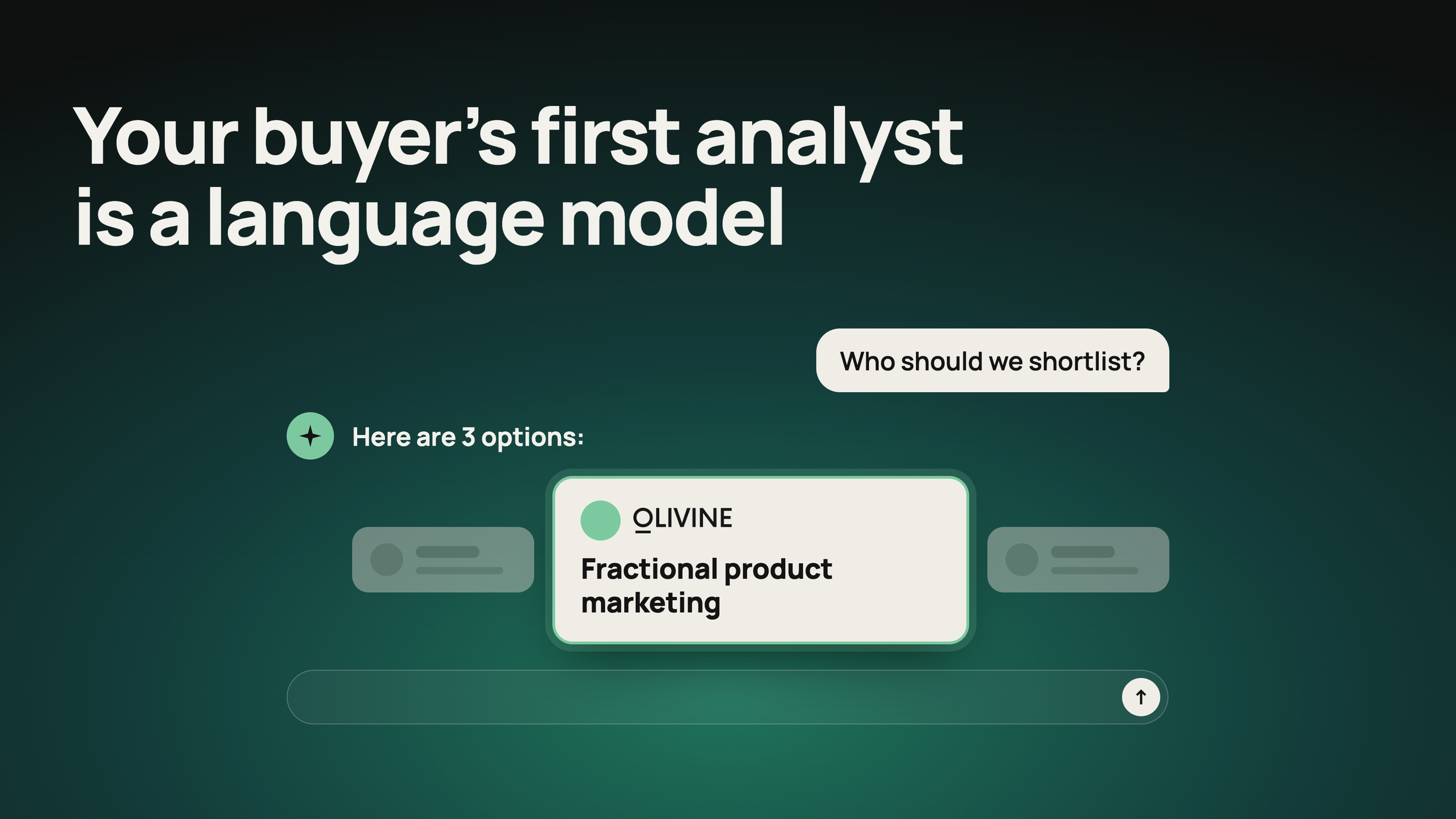
A Series A founder needs senior product marketing help but isn't ready to make a full-time hire. Before she opens a single agency website, she asks ChatGPT who she should talk to about fractional product marketing. The answer names three firms with a line on each, and that's her shortlist.
Olivine is a regular on lists like that one, largely thanks to work we did long before AI search existed. The part I watch most closely is the line under our name.
We recently moved our flexible product marketing offer from a marketplace model to a fractional one, where we add product marketers directly to a client's team, and the way we've handled that change is a working example of everything in this piece.
A model describes you from every page that mentions you, so a rename only lands once those pages tell the same story.
That rename sits inside a bigger shift. For most of the last decade, positioning got judged by a person reading your homepage, who could scroll, click through to pricing and ask a rep what you meant.
Now a model reads your site, your review profiles and everyone else's comparison posts, then hands the buyer a three-vendor shortlist and a one-line description of you that you don’t control.
This is already the default for a large share of buyers. In G2's March 2026 survey of 1,076 software buyers, 51% said they now start research in an AI chatbot more often than in Google, up from 29% eleven months earlier, and 69% said a chatbot's guidance led them to a different vendor than they had planned to buy.
The shortlist matters, too. 6sense's 2025 study of nearly 4,000 B2B buyers found the eventual winner was already on the buyer's day-one shortlist 95% of the time.
B2B marketers have dealt with this shape of problem before. Analyst firms have long compressed a category into a quadrant and a paragraph per vendor, and companies built whole analyst relations programs to influence that paragraph.
The model is the new first analyst. It reads more than any human analyst could, it never takes a briefing, and it writes a fresh paragraph about you every time someone asks.
Positioning for AI search means making sure the paragraph it assembles from every source about you matches the position you've actually chosen.
What A Model Actually Reads When It Describes Your Category
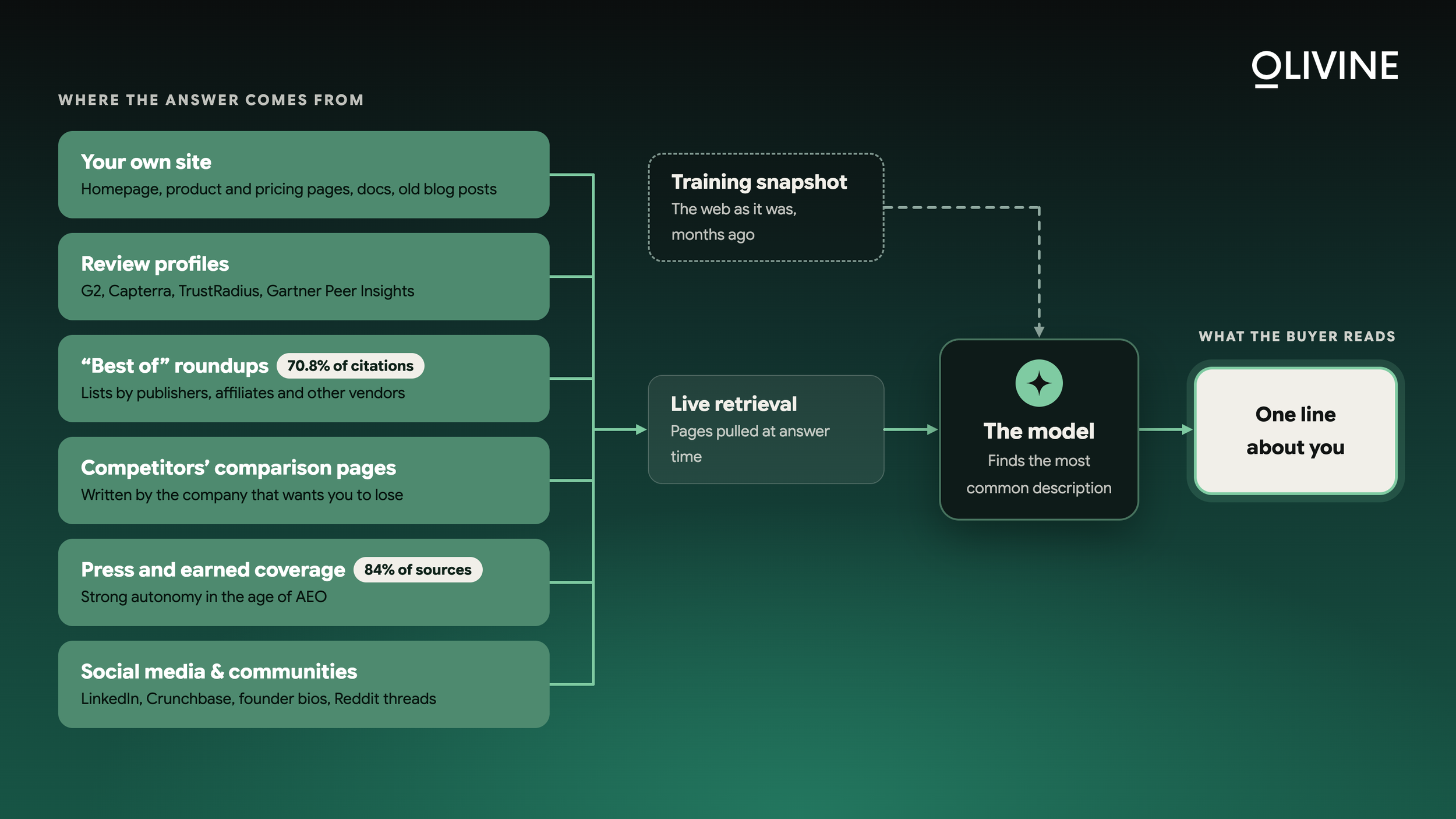
A model builds its answer from two places.
One is what it absorbed in training, a snapshot of the web taken months earlier, which is why old descriptions of a company outlive the positioning they came from.
The other is what it retrieves at answer time, when ChatGPT, Perplexity, Claude, Gemini or Google's AI Overviews run a live search and write the answer from the pages they pull.
Very little of what it retrieves is yours. A typical answer about a B2B category draws on some mix of these:
Your own site. The homepage, product and pricing pages, docs, and whichever old blog posts still rank for your category terms.
Review profiles. G2, Capterra, TrustRadius and Gartner Peer Insights, including the category you're filed under, the description on your profile, and what reviewers say about who the product suits.
"Best of" roundups. Lists written by publishers, affiliates and other vendors. In Overthink Group's study of 1,263 niche B2B software prompts, run in June 2026, 70.8% of citations pointed to "best" or "top" lineups.
Competitors' comparison pages. Every "them vs. you" page is a description of your product written by the company that most wants the buyer to pick someone else.
Press and earned coverage. Muck Rack's May 2026 analysis of more than 25 million links found earned media made up 84% of the sources ChatGPT, Claude and Gemini cited.
Profiles and communities. Your LinkedIn company page, Crunchbase, founder bios, conference speaker pages, and threads on Reddit.
In Olivine's case, some of the pages doing the most work are ones we didn't write. Long before buyers asked AI tools for recommendations, we were included in listicles of top product marketing agencies, and those lists still put us in front of models today.
Clutch does similar work, and it's where Olivine is the top-ranked product marketing agency on the Leaders Matrix.
Pages like these carry weight because models trust them, which is also why they matter so much when you reposition: they keep repeating whatever you said about yourself when they were written.
Put all of that together and your homepage becomes one voice among dozens. The model can't tell which description is current. It knows which ones it found, how often each claim repeats and which sources it trusts.
The Positioning That Survives Summarization, And The Positioning That Gets Dropped
A model writing one line about your company does what a busy analyst does with a 40-page briefing deck. It keeps what it can state plainly and confirm somewhere else, and it drops the rest.
A useful way to think about it is the agreement rule: a model repeats what your sources agree on and drops what only one source says.
Your homepage tagline appears on one page, so it rarely survives. The category G2 files you under appears on your profile, in every roundup that pulls from G2 and in half the comparison posts about you, so it almost always does.
| Survives the summary | Gets dropped |
|---|---|
| A category buyers already search for | A category you coined that nobody else uses |
| A named buyer, like "finance teams at 200 to 2,000 person SaaS companies" | "Modern teams" and "forward-thinking companies" |
| A difference someone can check, like "closes month-end in four days" | "Powerful," "intuitive" and "AI-native" |
| Claims your customers repeat in their reviews | Claims only your homepage makes |
| One sentence, used word for word in five places | Five versions of the sentence, one per team |
The first row is a big part of why we chose the word "fractional." It's the term buyers search for more often, and using it is already helping Olivine in Google and in AI answers.
A model can only match you to a question if you describe yourself in the words the buyer typed. "Marketplace" described how the work was delivered, while fractional product marketing describes what a founder is actually shopping for.
This is also the trap I wrote about in Too Technical or Too Late: The Two AI Positioning Traps. "AI-native platform for workflow automation" reads to a model as a category label every competitor shares, so it fills the gap with whatever a third party said, usually price, company size or a complaint from a review.
And as we argued in AI Won't Replace Great Product Marketers, AI optimizes toward consensus. A sharp claim with no outside support gets sanded down to the category average, while one your customers repeat in their own words survives.
Why Inconsistency Costs You More Than Weak Copy
Weak copy that's consistent gets repeated accurately. If your homepage, review profiles, LinkedIn page and press boilerplate all use the same plain sentence, the model will use it too, and the buyer will at least know what you sell. Inconsistent positioning gets repeated inaccurately.
When sources disagree, the model tends to fall back on whichever version shows up most often, and that's usually the oldest one, because it has had years to spread. That's why we're running our fractional rename as a full positioning project, in a set order.
The first step covers every page and profile we own, from service pages to directory listings and boilerplate, so a model finds the same description wherever it starts.
The second is reviews. We've put real effort into our Clutch profile, and the thing that matters most is recency. Every new review describes the work we're doing now, in a client's own words, so a model always has current material to pull from.
The third is the pages you don't own, and that step is the slowest for any company. Roundups and lists published before a change keep the old language, and publishers rarely have a reason to go back and edit a post from two years ago.
You can ask, and there are services that help, but the most reliable lever is making your own sources and your reviews so consistent that they carry the weight.
When you do want help with the outside pages, we recommend two tools worth knowing:
1. Noble, which focuses on the third-party articles AI models actually cite. It identifies the pages models already pull from for your category, handles the outreach and negotiation with publishers, places new mentions and refreshes existing ones that describe you wrong.
2. Omnibound, which covers measurement. It turns your buyer and market context into the questions buyers actually ask AI engines, then tracks where you're cited across ChatGPT, Perplexity, Gemini, Claude and Google AI Mode, prompt by prompt.
Used together, Omnibound shows you which sources need attention and Noble helps you change them.
Buyers notice when the story doesn't match. In the same G2 survey, 64% said they see inaccurate chatbot recommendations often or very often, and 45% said citations from review sites were the most confidence-inspiring signal in an AI answer. When your review profiles still carry the old story, the wrong answer arrives with its own proof attached.
The same damage happens from the inside. When sales, the homepage and the founder's LinkedIn each describe the product differently, a model averages them into something generic, and generic loses three-vendor comparisons.
That's the practical case for a single source of truth for positioning and messaging that every team and profile draws from.
Why The Positioning You Launch With Is The One That Sticks
The lesson I'd pass on from all this is about timing. The positioning you go to market with will live on every page that writes about you, including every list you get added to.
Third-party sites rarely update old descriptions, so the best time to get positioning right is before anyone outside the company has seen it.
We're applying that to a service we launched this year. Olivine now recruits full-time product marketers for clients, and we're bringing it to market in the order I'd recommend to any client: land the positioning first, then take it to every listing, so the first description that spreads is the one we want repeated.
Before a launch, rename or repositioning of your own goes public, settle these four things:
The category term - Use the words buyers already search for, even if your team has a favorite of its own.
The one sentence - Write the description you want every page to repeat, and get product, sales and leadership to agree on it.
Your own sources - Update the site, every service page, every profile and your boilerplate on launch day, before anyone else starts writing about you.
The pages that will copy you - Send the new description to the review sites, directories and lists you already appear on while the change is still news.
Run This Audit On Your Own Company This Week
This is the quickest way to see where your positioning for AI search actually stands. The audit takes an afternoon and needs a spreadsheet plus access to the major assistants, and running it before you change anything gives you a baseline to measure against.
1. Write down what you want the answer to be. Before you ask a model anything, write the one sentence you'd want a buyer to hear, covering your category, your buyer and the difference that matters. If your team can't agree on that sentence in ten minutes, stop and settle it first, because a model can only repeat a position you've taken. Olivine's free positioning and messaging guide walks through how to build one.
2. Ask five questions in four engines. Run each prompt in ChatGPT, Perplexity, Claude, and Gemini or Google's AI Mode. Use a fresh chat with memory turned off, and run each prompt three times, since answers vary from one run to the next.
| Prompt | What it shows you |
|---|---|
| "What does [Company] do, and who is it for?" | The one-line description buyers get |
| "What are the best [category] tools for [your ICP]?" | Whether you make the shortlist at all |
| "[Company] vs. [main competitor]: which is better for [core use case]?" | How the model frames your difference |
| "What are the downsides of [Company]?" | The objections a buyer brings to the first call |
| "What are the alternatives to [Company]?" | Your competitive set as the model sees it |
3. Score each answer against your sentence. For every answer, note the category it names, the buyer it describes, the differentiator it credits you with and the competitors it lists. Mark each one as right, outdated or wrong. Outdated tends to be the most common result, and it's also the easiest to fix.
4. Follow the citations. Where an answer is outdated or wrong, open the sources behind every outdated or wrong answer, then work in the order we did: the pages and profiles you own first, your review profiles second, everyone else last.
5. Put one sentence everywhere. Take the sentence from step one and use it word for word on your homepage, in your meta description and LinkedIn About section, on your review profiles and Crunchbase, in your press boilerplate and founder bios, and in your llms.txt file if you have one. The agreement rule rewards exactly this kind of repetition.
What This Does Not Change
A lot of this is the work that has always mattered for SEO. Olivine shows up in AI answers partly because we already ranked well in Google, on the strength of backlinks and those agency listicles. The work that earned us search rankings carried straight over, and I'd expect the same for most teams.
Buyers still make the final call with people. 6sense found 94% of buyers used LLMs during their purchase and still averaged 16 interactions per person with the vendor they chose, and in G2's 2026 Buyer Behavior Report, 40% of buyers said evaluation is now the longest stage of their purchase.
The model decides who gets considered, and the demo, the references and the rep still decide who gets the contract.
Good positioning hasn't changed either. A model can only repeat a position somebody took, and no amount of schema markup will invent one for you.
The sentences that survive summarization are the ones a buyer could repeat to their boss, with a real category, a named buyer and a difference they can check. Write those for people first, and the models will pick them up.
Work With Olivine On Your Positioning
Clients come to Olivine to decide who they're for and what to say, and that decision is exactly what a model ends up repeating about them.
Olivine's positioning and messaging work gets product, sales and leadership agreed on who you're for and how you're different, then turns that into the language every page and profile draws from.
Our competitive intelligence work covers the other side of the answer, including how competitors describe you and what buyers hear before your first call.
Frequently Asked Questions (FAQs)
Can you control how AI describes your company? Partly. You can shape how AI describes your company by keeping one description consistent across your website, review profiles, LinkedIn, Crunchbase and press boilerplate, and by correcting outdated third-party pages. Models repeat what their sources agree on, so consistency across those sources is the closest thing to control you'll get.
Does this replace SEO? No. AI search builds on SEO, since assistants like ChatGPT and Perplexity run web searches before writing many answers, so crawlable, plainly written pages still get found. AI search adds a second goal: being described accurately inside the answer, which depends on what other sites say about you as much as on your own pages.
Should you block AI crawlers? For most B2B SaaS companies, blocking AI crawlers costs more than it protects. OpenAI and Anthropic run separate bots for model training and for search, so you can block training while still allowing the search bots that let assistants cite you. Blocking everything leaves models describing you from third-party pages alone.
Where do models get their information about B2B vendors? Models get their information about B2B vendors from training data and from pages they retrieve at answer time. For software questions, that means vendor websites, review sites like G2 and Capterra, best-of roundups, competitors' comparison pages, press coverage, LinkedIn and community threads. The mix varies by engine, so check each one separately.
How often should you re-run the check? Re-run the AI positioning check every quarter, and again within a month of any repositioning, pricing change, rebrand or major launch. Assistants pick up changes unevenly, so a fix on your own site can take weeks to show up in their answers. Save each round's results in the same sheet so you can compare them over time.