
Sterile Positioning and Messaging: Why It Happens and How to Fix It
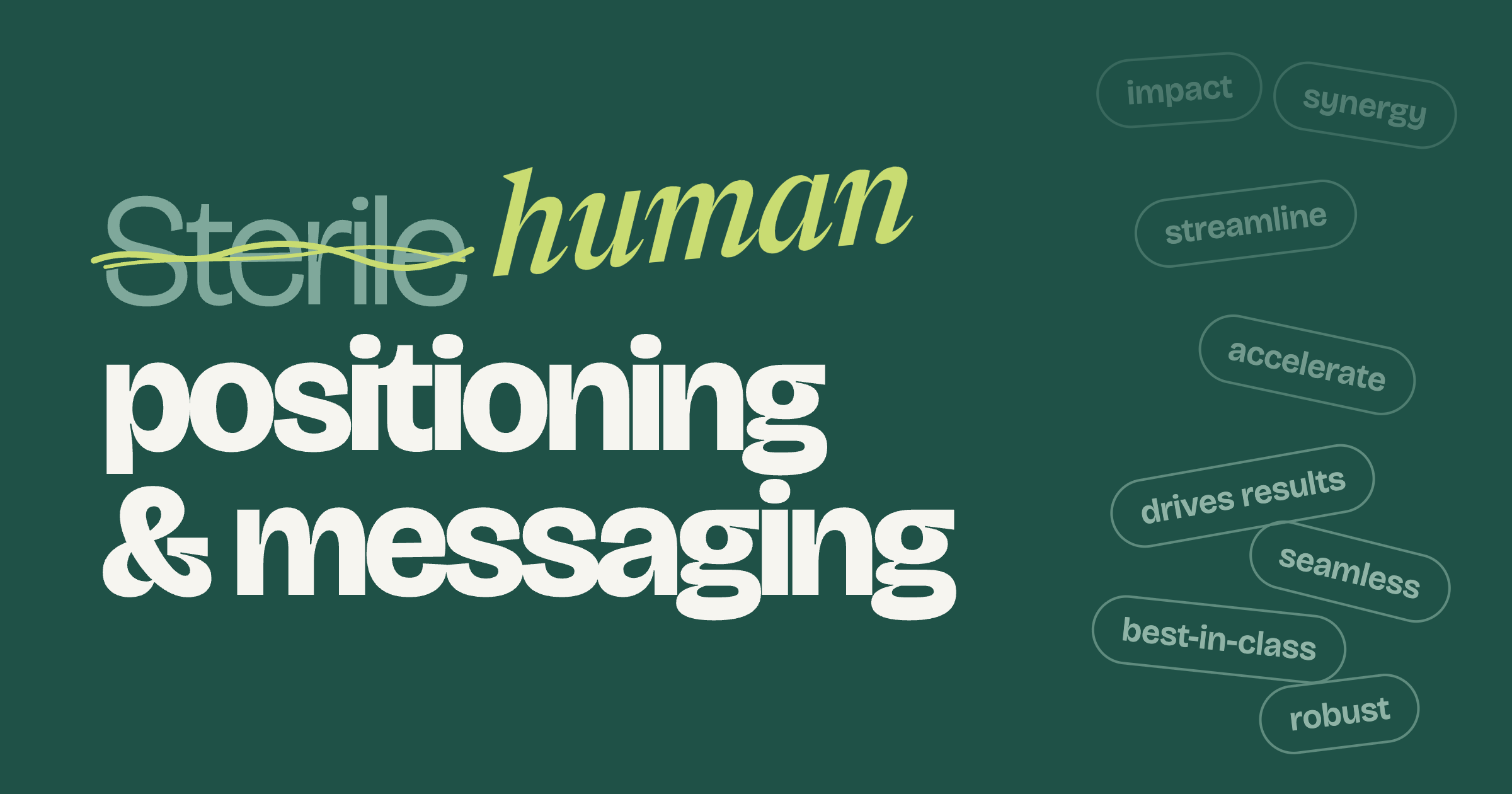
Messaging that resonates starts by being bold and going against industry standards. Yet tech companies have a tendency to build positioning and messaging that's market standard, and what's missing is asking ourselves: "Why?" Because it feels familiar. Because there's a fear of pushing away their audience. Well, unfortunately, tech companies are doing exactly that.
Many tend to get positioning and messaging confused, but to put a stop to it let's explain. Positioning is where your product fits in the market, who you serve, what you're doing, and how you're different. Messaging is the clarity of what you say about your product. Put plainly, positioning is what your product means to your customer, and messaging is how you'd describe it to a friend, not a market. Positioning decides whether you get considered. Messaging decides whether they actually listen, or tune you out. Both are the human argument for why your product exists and why it should be chosen.
Talk to your audience the way you talk to a friend
Somewhere between researching your audience, studying the market, and understanding your buyer, messaging and positioning lose their way. It's easy to get clouded by the work you're closest to, but what your audience wants is something different. People are used to reading sterile market language: "streamlining," "accelerate," "impact," "drives results," "easy to use." And we as marketers are just trying to convey the value we so strongly believe our product provides.
What we tend to miss is that our audience isn't a profile on a Google doc. They're humans, looking for human language.
A human way to frame positioning and messaging is to think as if you're speaking to a friend. Notice how you naturally change tone and language depending on who you're talking to.
How does Friend A prefer to be spoken to vs Friend B?
What kind of information matters to Friend A vs Friend B?
What do you do, as a friend, to comfort Friend A vs Friend B?
When you start to personalize your audience, you’ll naturally start to change the way you think of communication.
I know we as product marketers have led or sat in countless customer interviews and sales and CS calls, all arriving at the same conclusion: to know your audience. The biggest takeaways I continue to walk away with after are that customers can smell BS and they need consistent follow-through.
If a person is willing to speak with you, they better feel genuinely heard and you must keep your product promise, not just commit to a future plan. They need the product to work, to be effortless, and are so desperately looking for a company to put their words into action.
With markets as saturated as they are today, growing pains, and a never-ending list of to-dos, your audience wants to feel important in the message you’re delivering. They’re trying to trust you.
Why positioning and messaging comes out sterile
Sterile language is the easy choice. It's easier to frame your company around market language. People see it so often that they understand it instantly. It puts you in a category with your competitors, so there's no confusion, and it lets your audience automatically bucket you.
Speed over quality, and a lack of experimentation. In the era of speed, organizations prefer to deliver, launch, release, and move to the next feature. Experimentation can take time, consideration, and research. Many teams don’t have that time, don't want to make it, or don't see it as a priority.
Cross-functional inconsistencies. More often than not, product, engineering, marketing, sales, and customer success each carry a different belief about what their product is and where it's headed.
Lack of organizational buy-in. Leadership can sit too far from the customer, swaying messaging toward what they think the company should say rather than what it actually needs to say.
Change is hard. Businesses can be scared to change and be different. They have quotas to hit, personalities to manage, and needs to balance. Predictability is safer.
How to write positioning and messaging that sounds human
First, start internally. Knowing your internal audience matters just as much as knowing your external one. As a marketer, it can feel like your job to make everyone happy, but really, your job is to speak for your external audience in a way that resonates with your internal one. Never stop asking questions of either.
Measure what matters. Cross-functional teams can disagree because everyone's speaking from a different vantage point. Pull qualitative data from customer interviews, support tickets, and sales call transcripts. What your audience actually says and feels will tell the story.
Make room for experimentation. You don't need a quarter-long research project for testing. Run two homepages, and track them. Constantly interpret what the data means and how it could shape your messaging. If you don't have time to speak with customers, A/B test with an AI agent.
Bring a recommendation, not just options. Pitch it alongside the alternatives, and stay open to your internal audience adding to it. Sometimes the best answer isn't A, B, or C. It's D, the A and C you weren’t planning on combining.
You've got the proximity your teams don't. Cross-functional inconsistencies will always show up, but you can narrow them. Pull an engineer or a sales rep into a customer check-in, an event, a round table, something you, as a product marketer, are already leading. That gives them the same layer of insight into your audience that you have.
Think back to Friend A and Friend B. You already know how to adjust your tone and speak to someone like they're a person and not a segment. You do it every day, with everyone in your life except, somehow, your customers.
The bottom line: it's worth the effort. When your customers can see themselves, and what they actually need, in your product, the words stop being the point. The connection is.
Where to start
If you want a place to begin, our positioning and messaging guide walks through the same questions we ask clients in week one, including the template we use to pressure test language before it goes anywhere near a homepage. And if this is work your team knows it needs but cannot get to, that is most of what we do.
Frequently Asked Questions (FAQs)
What is the difference between positioning and messaging? Positioning is what your product means to your customer, the place it holds against every other option they could pick. Messaging is how you say it, in the words you would use with a friend rather than a market. Positioning is the decision. Messaging is whether anyone listens.
What is product positioning? Product positioning defines what your product means to a specific customer and where it stands against the alternatives they are weighing. It is an internal decision that shapes everything external, from your homepage headline to how a sales rep opens a call. Messaging cannot rescue positioning that is wrong.
Why does so much B2B messaging sound the same? Because market standard language is the safe choice. It is understood instantly, it survives internal review, and it files you neatly into a category alongside your competitors. The cost is that buyers cannot tell you apart from the other vendors on their shortlist, so they stop reading.
How do you write messaging that sounds human? Write it the way you would explain your product to a friend, then read it out loud. If a sales rep would not say the sentence on a call, cut it. Replace words like streamline and accelerate with the specific thing your customer gets to stop doing.
How often should you update your positioning and messaging? Review messaging twice a year, and immediately after anything that changes your buyer: a new segment, a pricing change, a competitor entering, or a product shift. Positioning should hold steady for longer. If you are rewriting it every quarter, the problem sits upstream in strategy.