
Too Technical or Too Late: The Two AI Positioning Traps
Every prospect I’ve talked to lately falls into one of two camps. Not most of them. Every single one.
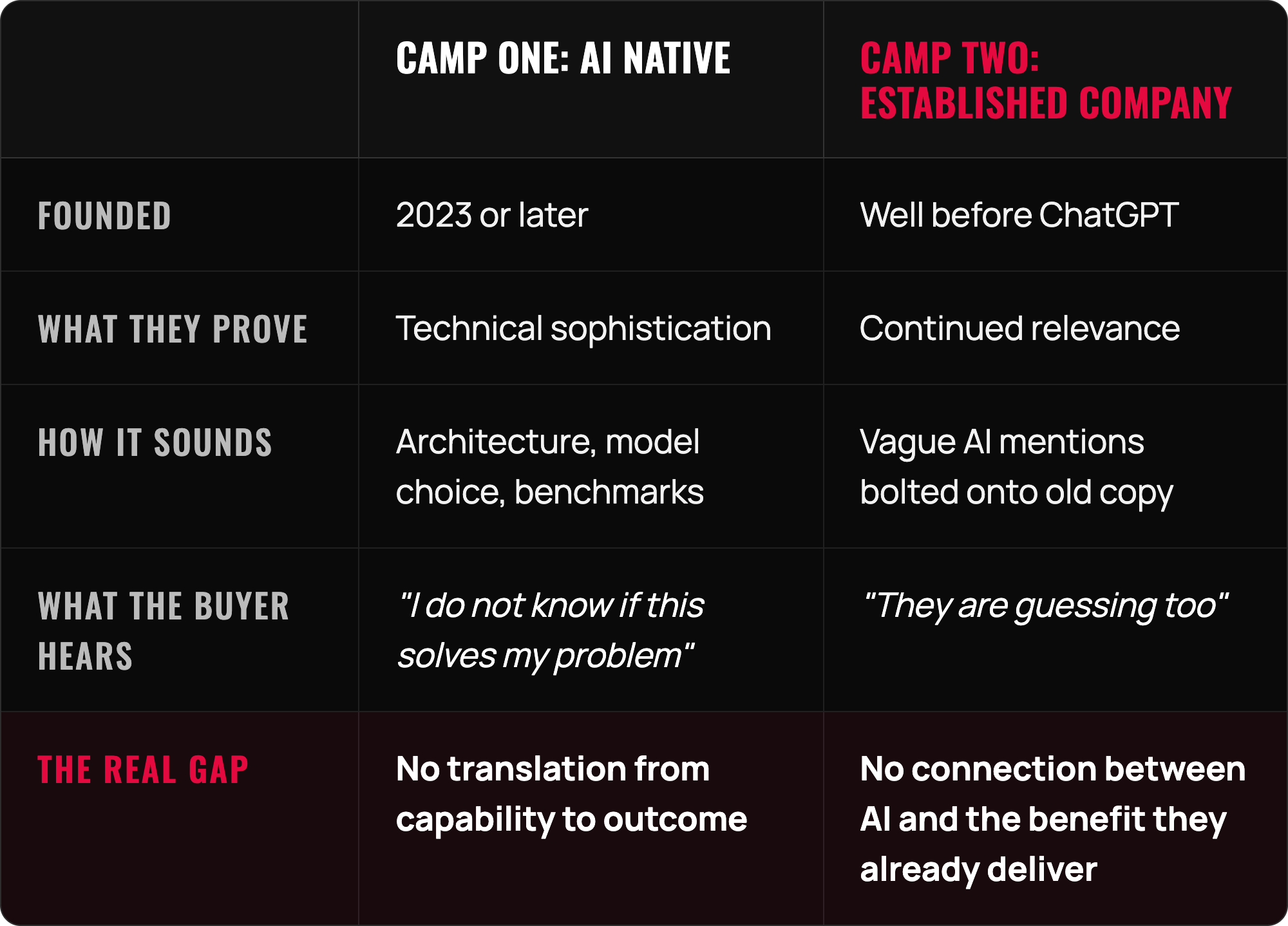
Camp one is AI native. Founded after 2023, usually by engineers, and the founder can explain the architecture better than anyone else in the room. What that founder cannot do is explain the value to a buyer who does not care about the architecture.
Camp two was founded well before ChatGPT existed. Real customers, real revenue, and a quiet fear that the market moved without them. One company I spoke with recently has been in business for twenty-five years and does not mention AI anywhere on its website.
On the surface, these problems seem opposite. One sounds too technical. The other sounds outdated. I treated them as separate conversations for weeks before I realized I was giving both the same advice.
They're two sides of the same coin, both spending their energy proving what they are instead of what they deliver.
Identity positioning versus outcome positioning
Identity positioning tells the market what category you belong to. Outcome positioning tells the market what changes for the buyer when they choose you. Nearly every company believes it is doing the second. Most are doing the first, because category language is faster to write and almost impossible for anyone in a review meeting to argue with.
"AI native platform for enterprise workflow automation" is identity. No one in that approval chain will object. It also tells a buyer nothing about what will be different on Thursday.
This is a positioning problem before it is a messaging problem, and the two constantly get collapsed. Positioning is the decision about what you are for and who you beat. Messaging is how you say it. Better wording will not rescue a decision that was wrong to begin with.
That is the trap both camps fall into. They just fall in from opposite sides.
Camp one: when the architecture becomes the pitch
Technical founders position around architecture for a fair reason. It is the part they fought for, it is hard, and it is what their peers respect them for.
The problem is that "AI native" stopped being a pitch and became a category descriptor. Every product has AI now. Saying you are AI native in 2026 is like saying you are cloud-based in 2016. It puts you in a room, but it does not distinguish you inside it.
I saw this play out firsthand with Anvai, an AI research platform for asset and wealth management called AIRA. The founding team is made up of scientists and engineers, and the product itself is genuinely sophisticated: it's built on their own orchestration platform, Tolka, and encodes an analyst's actual mental models instead of just chatting over documents. But their buyers are financial professionals, not technical ones. The pitch had to translate all of that complexity into a plain problem-and-solution story before it would land.
That's not a messaging problem. It's a buyer persona problem. Once we rebuilt the positioning around the buyer's world instead of the platform's architecture, the difference showed up immediately: stronger engagement and better reactions in their sales pitches and demos.
The fix is not dumbing anything down. It is sequencing. Lead with the outcome, then use the architecture as proof of why you can deliver it when others cannot. Same facts, reversed order. The technical depth becomes evidence, not the opening argument.
If you are early enough that positioning still feels premature, it is not. We have written about what happens when founders skip product positioning at the early stage, and the pattern is consistent. The technical work gets the attention, and the positioning gets postponed until a sales cycle stalls. Positioning belongs near the front of the twelve stages of taking a new product to market, not as cleanup after launch.
Camp two: the relevance scramble
The second camp does the opposite and fails for the same reason.
They add AI to the homepage. They release an AI feature nobody asked for. They sprinkle the word through copy written for a different decade, and the result reads like a company trying to convince itself.
This is AI washing. It’s when a company overstates or vaguely implies AI capability to appear current, and buyers have gotten fast at spotting it. The tell is always the same: the AI claim floats free of any specific outcome. It sits next to the benefit rather than explaining it.
My advice to the twenty-five-year-old company was not to start talking about AI everywhere. It was the opposite. Do not turn into an AI company. Stay focused on the benefit you already provide, weave AI in where it genuinely enhances that benefit, and let your history and your newest work both do the talking.
AI has changed how product marketing gets done, so there is real work to point at. Before any of it reaches your positioning, ask whether it changed what the customer receives or only how your team produced it. Only the first belongs on the website.
Twenty-five years of solving a problem is not a liability to be papered over. It is the single hardest thing for a company founded in 2023 to claim. Long tenure builds things a new entrant cannot buy quickly: proof across the edge cases, integrations that already work, and switching costs that make leaving expensive. When an incumbent buries all of that under AI language, they trade their most durable advantage for a claim every competitor is making at the same volume.
We have clients doing exactly this right now. One built its entire pitch around being an AI company, and it worked, until their buyers started getting burned by everyone else promising AI magic. The same positioning that won them customers began working against them. We rebuilt the messaging to lead with the benefit and moved "supported by AI technology" to a secondary line. Trend-based positioning has a shelf life. Benefit-based positioning doesn't.
The test that works for both camps
Here is the rule I give every client, and it costs nothing to run.
Take any sentence in your positioning and ask whether a competitor could put their logo on it and publish it unchanged. If the answer is yes, you have written identity, not outcome. Cut it or rewrite it.
Then run the second half of the test. Ask whether the sentence names something the buyer can verify after they buy. "AI powered insights" cannot be verified. "Surfaces the three accounts most likely to churn this quarter, before your CSM has read the ticket queue" can be. One of those sentences survives contact with a renewal conversation. The other one does not.
Most positioning fails this test on the first pass. That is not a sign the team writes badly. It is a sign the copy was built to be approved rather than built to be true, which is a different job with a different output. A model can draft the sentence in seconds. Deciding whether the sentence is true is the part of this work that has not been automated.
If you want to see what that rewrite looks like on real accounts, we published the before-and-after positioning we built for several clients.
What to do this week
If you are camp one, take your three strongest technical claims and write the buyer outcome each one produces. Not the feature. The change in the buyer's week. Then rebuild your homepage hero around the outcome and move the architecture down the page as proof.
If you are camp two, do the reverse audit. Find every place AI appears in your copy and ask what specific outcome it improves. Where you can name one, keep it and make it concrete. Where you cannot, delete it. An honest page that says nothing about AI beats a page that says AI without saying why.
Both camps should then do the same thing: take the rewritten language to three customers and three reps and read it out loud. If nobody reaches for it naturally, it is not finished. Messaging that survives internal review but dies on a sales call is the most common expensive failure in product marketing, and it is entirely preventable.
Good AI product marketing is mostly this one decision, made over and over: what to lead with, and what to hold back as proof. The companies that get through this period will not be the ones that proved hardest that they belong to the AI category. They will be the ones who kept the buyer's outcome at the front of every sentence and let the technology quietly do its job.
Thinking about your own positioning? We help B2B companies figure out what to lead with and what to prove. Talk to us about positioning and messaging.
Frequently asked questions about AI positioning
What is AI washing? AI washing is overstating or vaguely implying AI capability to appear current. The tell is an AI claim that floats free of any specific outcome. Buyers spot it quickly because the language sits next to the benefit rather than explaining it, which signals the company is positioning for perception rather than results.
How should an AI company position itself? Lead with the buyer outcome, then use the architecture as proof you can deliver it. "AI native" is a category descriptor now, not a differentiator. Technical depth still matters, but it works as evidence for a claim the buyer already cares about, not as the opening argument.
Should an established company reposition around AI? No. Stay focused on the benefit you already deliver and weave AI in only where it measurably changes that benefit. Years of solving a problem is the hardest thing for a 2023 startup to claim. Burying that under AI language trades a durable advantage for a claim everyone is making.
Why do technical founders struggle to explain their product's value? The architecture is the part they fought hardest for, so it feels like the most important thing to lead with. It is also what earns respect from peers. Buyers evaluate a different question: what changes for them after purchase. Founders answer the first question and assume it answers the second.
How do you know if your positioning is actually differentiated? Ask whether a competitor could put their logo on the sentence and publish it unchanged. If yes, you wrote identity rather than outcome. Then ask whether the buyer can verify the claim after purchase. Language that fails both tests was written for internal approval, not for the market.