
Go-to-Market Strategy Consulting: What It Is and When You Need It
Go-to-market strategy consulting is the practice of bringing in outside experts to build or fix a company's plan for how a product reaches customers and generates revenue. It covers positioning, messaging, audience targeting, launch planning, and sales enablement. Companies turn to go-to-market (GTM) consultants when they need to move fast, lack a senior marketing leader, and cannot afford to get the foundational strategy wrong.
Many of the B2B SaaS companies we've worked with had a strong product. What slowed them down was the story around it. The market never got a clear picture of who the product was built for, what problem it solved, or why it was worth choosing over what buyers were already using. Getting that clarity is what a go-to-market strategy is supposed to deliver, and it's harder to get right than most founding teams expect.
This guide explains what a go-to-market strategy is, what GTM consulting actually includes, and the signs that it's time to bring in outside help.
What Is a Go-to-Market Strategy?
A go-to-market (GTM) strategy is a company's plan for how a product reaches customers and generates revenue. It answers four core questions:
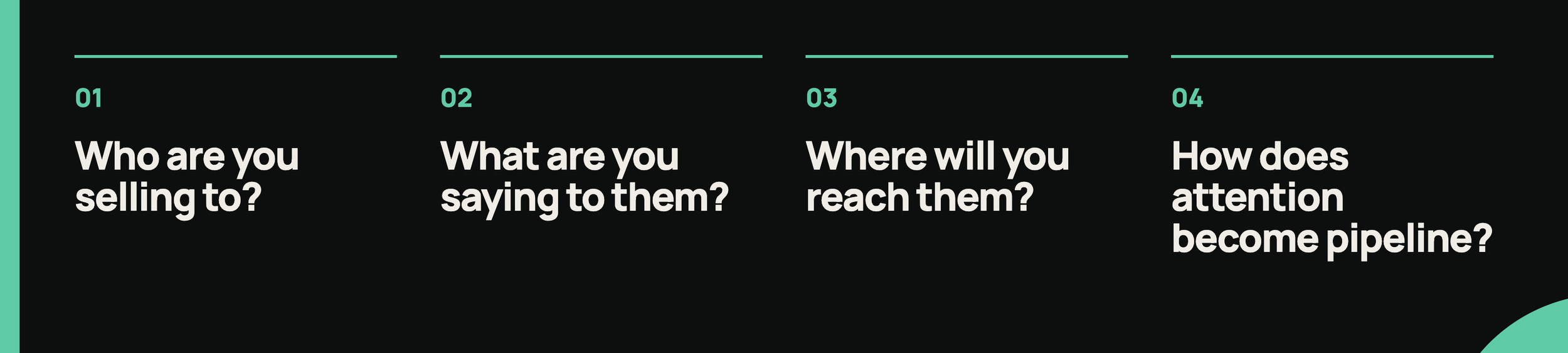
Who are you selling to?
What are you saying to them?
Where will you reach them?
How will you convert their attention into pipeline?
A GTM strategy serves as a customer acquisition strategy: it determines who you're pursuing, how you're converting them, and what keeps them coming back. Without one, even strong products tend to struggle. The symptoms are familiar: inconsistent messaging, unclear audiences, sales conversations that go sideways, and growth that depends more on luck than a repeatable system.
A marketing plan, a media buy, and a product roadmap are all downstream of a go-to-market strategy. The GTM strategy determines who those efforts are aimed at, what they say, and whether any of it should work. When the foundation is unclear, more spending on execution tends to amplify the problem rather than solve it.
What Is Go-to-Market Strategy Consulting?
Go-to-market strategy consulting is when a company brings in outside experts to build or fix its go-to-market strategy alongside the internal team. Rather than hiring a full-time marketing leader, which can take months and typically costs $150,000 to $250,000 or more in base salary alone, companies work with consultants who have launched dozens of products across different stages and markets. They bring frameworks, pattern recognition, and execution experience tailored to the specific product and situation.
Good GTM consultants work alongside the internal team to make decisions that can be acted on: which segment to lead with, what the homepage should say, how to sequence the launch, what to measure in the first 90 days. The goal is a working strategy the team can own and execute right away.
What Does Go-to-Market Consulting Include?
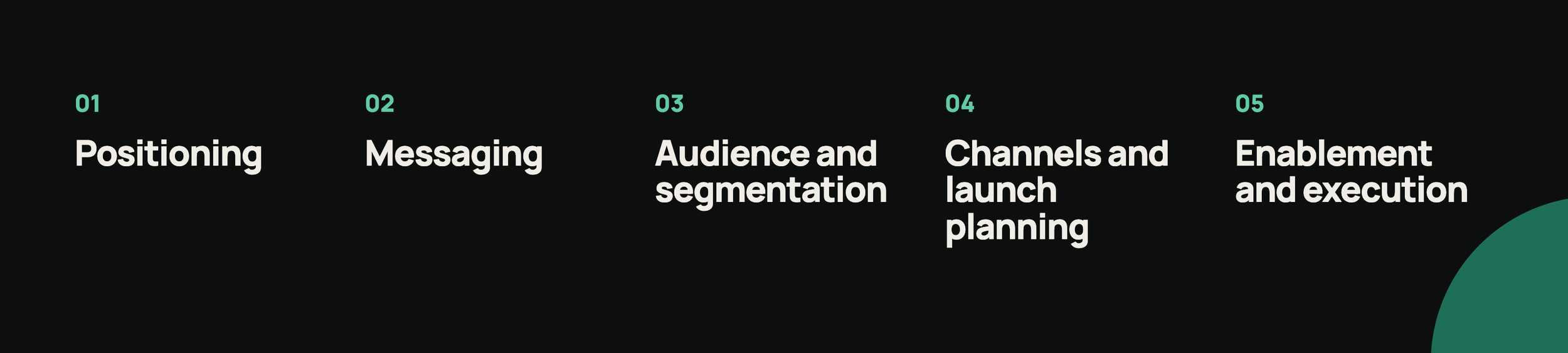
Most go-to-market consulting engagements work through five interconnected areas. Positioning, messaging, audience and segmentation, channels and launch planning, and enablement and execution, with each building on the last.
1. Positioning
Positioning defines who the product is for, what problem it solves, and why it's a better choice than the alternatives, including doing nothing. Positioning is the foundation everything else builds on. In our experience, positioning problems are almost always misdiagnosed as sales problems. The leads are there, the pitch just doesn't land, and better sales training rarely helps.
2. Messaging
Messaging translates positioning into the actual words buyers encounter: on the website, in the sales deck, and across campaigns. Good messaging makes a prospect think, "They understand my problem." For B2B teams, it's worth building messaging your sales team will actually use from the start. The test of good messaging is whether reps reach for it naturally in sales conversations.
3. Audience and Segmentation
This step identifies which customers to lead with. Not just who could buy, but who is most likely to buy first, stay longest, and refer others. It includes buyer persona and ICP development, customer interviews, competitive analysis, and mapping the buying journey from first awareness through close.
4. Channels and Launch Planning
Channels and launch planning determine where to reach the audience and in what order. Which channels fit the company's motion: sales-led, product-led growth (PLG), or community-led? What does the 90-day go-to-market plan look like? This is also where sales and marketing alignment happens. Both teams need to be working from the same targeting, messaging, and lead handoff process before launch. For a detailed breakdown of how this sequencing works, Olivine's guide to the 12 stages of taking a new product to market covers the full arc.
5. Enablement and Execution
Enablement and execution produces the assets that make the strategy operational: website copy, sales decks, one-pagers, battlecards, email sequences, and the customer success handoff. The goal is an operational plan, not a strategy document.
Very little of this involves running ads. GTM consulting sits upstream of channels and campaigns. When the strategy is unclear, more spending on those channels tends to reach more of the wrong people.
Why Is a B2B or SaaS Go-to-Market Strategy Different?
For a B2B go-to-market strategy, the cost of getting positioning wrong compounds quickly. B2B sales cycles often run three to six months or longer, deal values are larger, and the pool of qualified buyers in any given segment is finite. Weak positioning in a long B2B sales cycle means months of effort on deals that were unlikely to close from the start. Customer success also becomes part of the GTM motion: how customers are onboarded and retained shapes referrals, expansion revenue, and the case studies that close the next deal.
For a SaaS go-to-market strategy, there's the added complexity of choosing a motion. Sales-led, product-led growth (PLG), and community-led models each require different approaches to positioning, pricing, and channel strategy. A PLG motion that works well for a $29/month tool will fail for a $50K enterprise deal, and vice versa. Figuring out which motion fits the business is often one of the first things a GTM consultant helps a team work through.
The discipline is the same in either case: understand the buyer specifically, commit to a clear point of view, and keep the story consistent across every touchpoint. You can read more about winning go-to-market strategies across different motions and company stages on Olivine's blog.
Signs You Might Need Go-to-Market Strategy Consulting
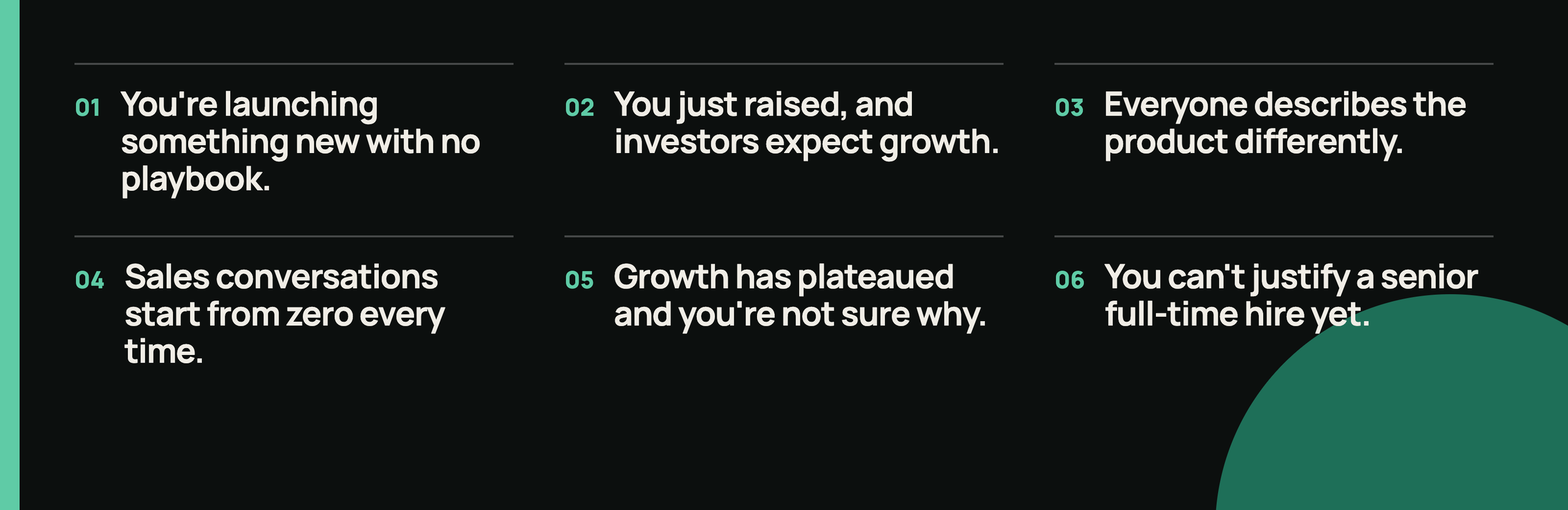
The clearest signals tend to show up in the day-to-day, often long before anyone names the problem.
You're launching something new and there's no playbook. A first product, a major new feature, or a move into a new market. The team is strong on building, but nobody has run a full launch before and the deadline is real. Startups in this position often underestimate how much runway gets burned when the launch story isn't clear from day one.
You just raised, and investors expect growth. A funding round comes with expectations and often a board asking pointed questions about pipeline. A credible GTM plan needs to exist before a full marketing department does.
Everyone on your team describes the product differently. Ask three people what the company does and get three different answers. That inconsistency tends to cost deals. Buyers who don't see themselves in the story rarely move forward.
Sales conversations start from zero every time. Reps are improvising the pitch, rebuilding decks, and answering the same objections from scratch on every call. Before blaming the sales team, it's worth checking whether the positioning and enablement are doing their job.
Growth has plateaued and you're not sure why. Early adopters came easily; the next segment isn't converting. Olivine's piece on how early-stage startups can close the traction gap covers several of the most common reasons this happens. Usually the product is fine, but the story and targeting haven't evolved with the market.
You can't justify a senior full-time hire yet. A VP of Marketing is a significant investment, with base salaries typically running $150,000 to $250,000 or more at growth-stage companies. Hiring one before the strategy exists often ends badly for both sides. If you're weighing what kind of marketing help makes sense at your stage, Olivine's breakdown of your first marketing hire is worth reading. Consulting lets you build the foundation first, then hire into a clear mandate.
If two or more of these sound familiar, outside GTM help tends to pay for itself quickly.
A Real-World GTM Consulting Example
Safer, an all-in-one CSAM detection, removal, and reporting solution developed by Thorn, needed to clarify its positioning and build a long-term marketing direction. As a highly technical product operating in a sensitive space, the challenge was figuring out how to reach and engage a very specific audience in a way that matched both the product's complexity and the seriousness of the problem it addresses.
Working with Olivine, the team ran a series of foundational product marketing workshops grounded in customer research. That work produced buyer personas and journey maps, a positioning and messaging guide, a three-year strategic marketing plan, a two-year tactical roadmap aligned to company OKRs, and a full website content refresh.
The result was a coherent strategy that gave the Safer team a shared language for who they were talking to and why, across marketing, sales, and leadership. You can read the full Safer case study on Olivine's site.
"Olivine helped us define who we are talking to and how we will position our product. They listened to the perspectives of many internal stakeholders and took the time to understand our highly technical product and our highly sensitive industry. Throughout the entire process, they kept us focused on the human elements: our customers and the ultimate impact our product will have."
— Bilal Lakhani, Communications & Marketing Director at Thorn
In-House vs. GTM Consulting: Which Is Right for You?
For most early-stage companies, this comes down to timing rather than a permanent choice.
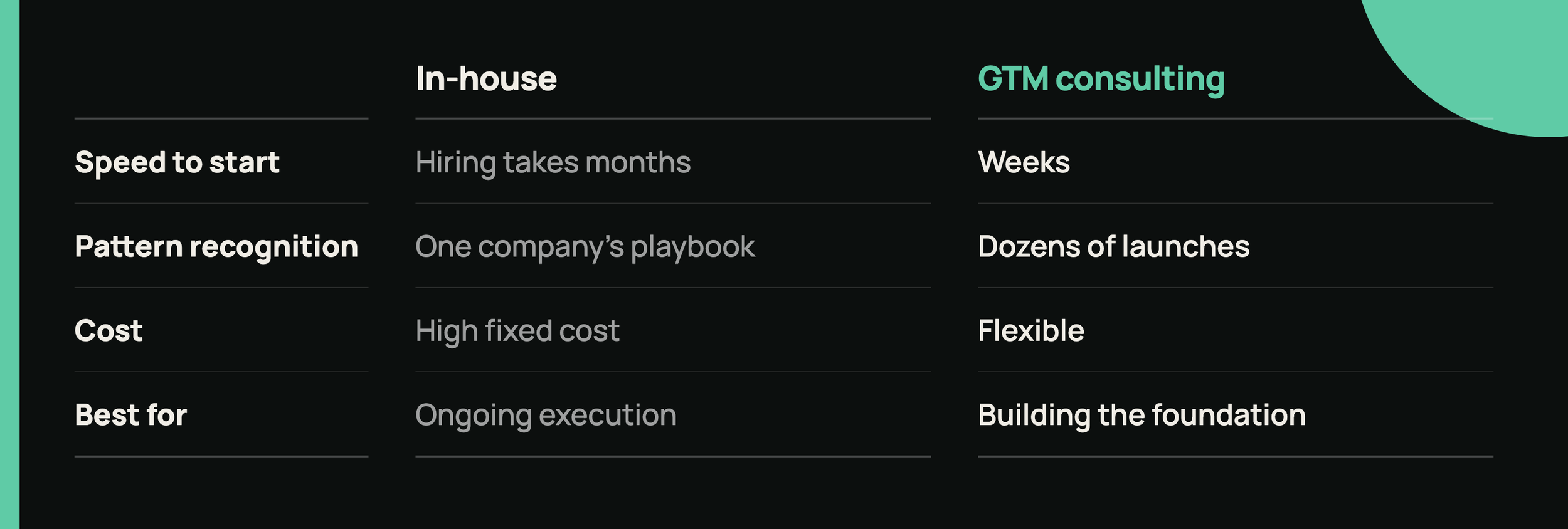
In-House
Slow speed to start, hiring takes time
Deep product context
Pattern recognition built on one company’s playbook, narrow
High fixed cost
Best for ongoing execution
GTM Consulting
Fast speed to start
Product context built through research
Broad pattern recognition, seen many launches
Flexible cost
Best for building the foundation
Early on, when a company can't yet support or attract a senior in-house team, consulting fills the gap. Later, the two work well together: consultants set strategy and build foundations; the internal team executes and owns it over time.
What Should You Look for in a GTM Consulting Firm?
Not all go-to-market consulting firms work the same way. These questions are worth asking before engaging one.
Do they start with research? Good GTM consultants talk to your customers before recommending anything. Any firm that skips research and leads with recommendations is working from assumptions rather than insight. Before and after examples, like Olivine's breakdown of how positioning and messaging evolved for past clients, can show you how a firm actually thinks through these problems.
Do they stay through execution? Strategy-only engagements tend to produce decks that gather dust. The right partner is there when the website copy needs to be written and the sales deck needs to land in front of a real buyer.
Have they worked in your space? B2B SaaS, consumer, enterprise, and services businesses all have different GTM motions. Pattern recognition across similar situations is a large part of what a consulting engagement delivers.
How do they define success? The answer should include pipeline, conversion rates, and sales cycle velocity rather than outputs like "a completed positioning document."
Who actually does the work? Some firms staff senior partners to win the deal then hand off to junior consultants. Ask who will be embedded in the engagement from week one through close.
How Olivine Approaches GTM Consulting
Olivine is a B2B SaaS product marketing agency founded in 2016, focused specifically on go-to-market strategy, positioning, and messaging for growth-stage technology companies. We've worked with companies from seed stage through Series C across industries including cybersecurity, logistics, developer tools, and fintech, and have been recognized as a top agency by Clutch and 50Pros.
We work as an extension of the client team rather than an outside advisor. That means starting with customer interviews, competitive analysis, and a close look at what's already working before recommending anything. From there, we build the positioning, messaging, and launch plans and stay through execution: the website copy, the sales materials, the launch itself.
Browse the full client portfolio to see the range of companies we've worked with, or read the Safer case study for a detailed example of what a full GTM engagement looks like in practice.
Frequently Asked Questions About Go-to-Market Strategy Consulting
What does a go-to-market consultant do? A go-to-market consultant defines who a company sells to, what it says to them, and how it reaches them. Typical engagements cover positioning, messaging, audience research, competitive analysis, launch planning, and sales enablement: the decisions that shape how effective everything else becomes.
What is the difference between a GTM strategy and a marketing strategy? A GTM strategy comes first. It defines the audience, positioning, and offer before any channels are chosen. A marketing strategy sits inside it and decides how to use channels like content, paid, email, and social to reach an audience that has already been identified.
How long does a GTM consulting engagement take? A focused positioning and messaging sprint usually takes four to six weeks. A full launch engagement, from customer research through execution, runs three to six months. Teams with existing customer insight and a clear view of their competitors move faster than teams starting from scratch.
What is the difference between GTM consulting and a fractional CMO? GTM consulting is project based and delivers specific outputs: positioning, messaging, launch plans, and enablement assets. A fractional CMO is embedded part time and leads the team. The two pair well, with a consultant building the strategy and a fractional CMO leading the team that executes it.
Olivine offers fractional product marketing consulting for companies that need embedded expertise without a full-time hire.
Work With a Go-to-Market Strategy Consultant
If you're staring down a launch, a funding milestone, or a growth plateau and want to know whether GTM consulting makes sense for your situation, visit Olivine's Go-to-Market Strategy services page to see how the firm works, or reach out directly to talk through where you are and whether there's a fit.