
Fractional vs. Full-Time Product Marketing Manager: Cost, Speed, & When Each Makes Sense
You know you need help with product marketing. What you don't know is whether that means hiring a full-time product marketing manager or bringing someone on a fractional basis. The two paths cost different amounts, move at different speeds, and carry different risks. Here's how to tell which one is right for where your company is today.
The Quick Answer: A fractional product marketing manager is a PMM who works with your company part-time, typically 5 to 20 hours a week, at a fraction of full-time cost and with no long-term commitment. A full-time PMM is a dedicated employee doing the same job at full capacity. Fractional makes sense when you need senior judgment now but don't yet have 40 hours a week of steady PMM work. Full-time makes sense once that work is consistent and you need someone embedded daily.
Same role, different commitment
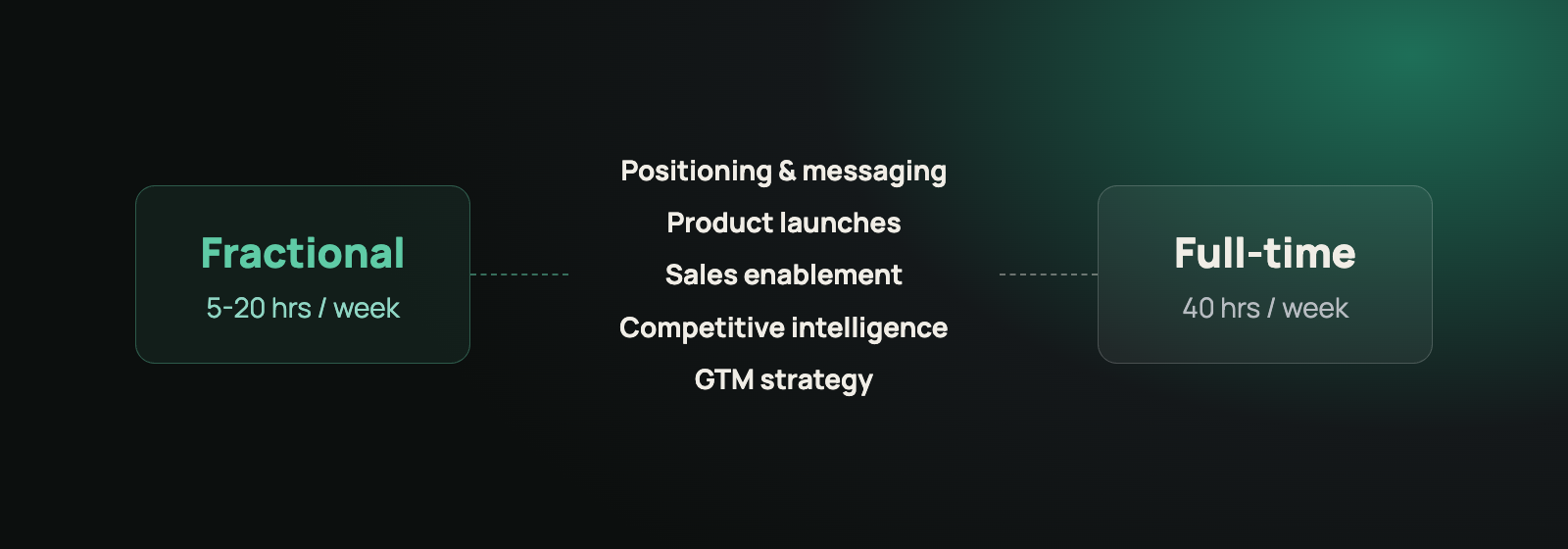
Whether full-time or fractional, a product marketing manager has the same core job description: positioning and messaging, product and feature launches, sales enablement (pitch decks, battlecards, one-pagers), competitive intelligence, customer and market research, and go-to-market strategy for new releases. Some PMMs also touch website copy, help center content, and onboarding campaigns.
What changes between fractional and full-time isn't the scope of the role. It's how much of it you're buying, how fast you can start, and how much risk you're taking on to get there.
Cost comparison: salary vs. hourly
A full-time product marketing manager at a B2B SaaS company typically commands a base salary in the low- to mid-six figures before bonuses, equity, and benefits. That number climbs further for a director-level hire managing a team. Add in the fully loaded cost of benefits, payroll taxes, and onboarding time, and the real annual cost of a full-time PMM hire is meaningfully higher than the salary number alone suggests.
A fractional product marketing consultant is priced either by the hour or on a weekly retainer. At 5 hours a week, you're paying for strategic advice and review: GTM plan input, launch plan sign-off, mentoring a junior marketer. At 10 to 20 hours a week, you're paying for both strategy and real execution: full launch ownership, sales enablement content, positioning overhauls. Either way, the monthly cost of a fractional PMM can be a fraction of a full-time salary, with none of the benefits overhead, recruiting cost, or severance risk if the hire doesn't work out.
The trade-off is capacity, not competence. A fractional PMM at 10 hours a week isn't a lesser product marketer. They're a senior one, just working a smaller slice of the week, often across multiple clients.
Speed to impact
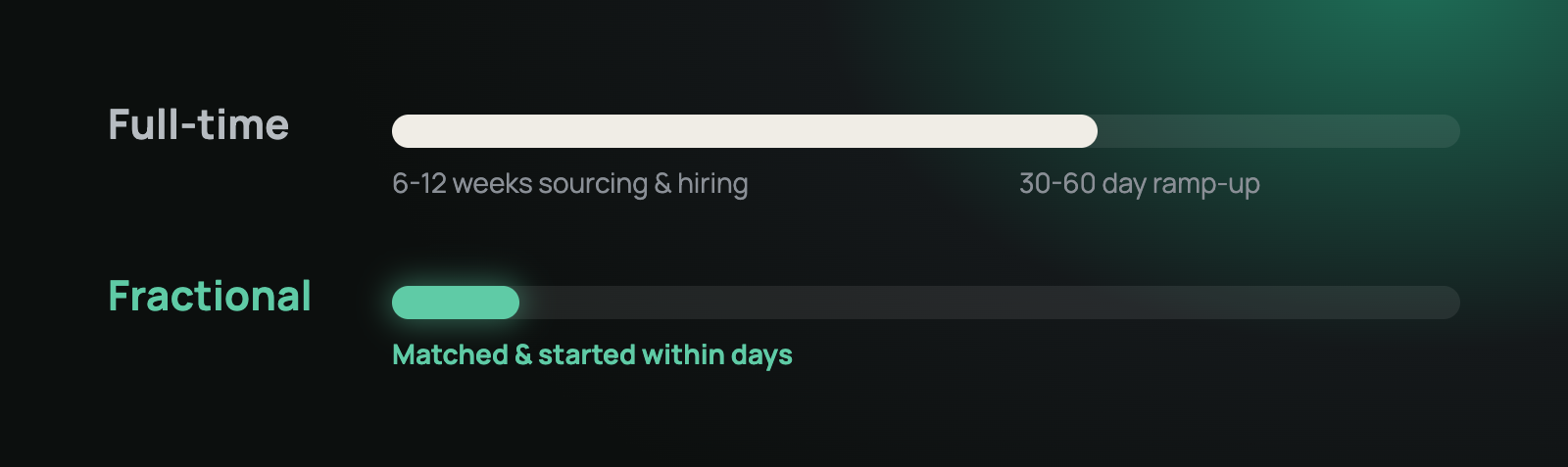
Full-time hiring for a PMM role typically takes 6 to 12 weeks of sourcing and interviewing before an offer is signed, followed by a 30- to 60-day ramp-up before the new hire is fully productive. That's a real gap, often three to four months, between deciding you need help and actually having it.
Fractional hiring compresses that timeline. A vetted fractional PMM can typically be matched and started within days, not months. Because they've done this exact job at other B2B SaaS companies before, they're able to contribute meaningfully in the first week rather than the second month.
If you have a launch on the calendar in six weeks, that speed difference alone can decide which path makes sense.
Flexibility and risk
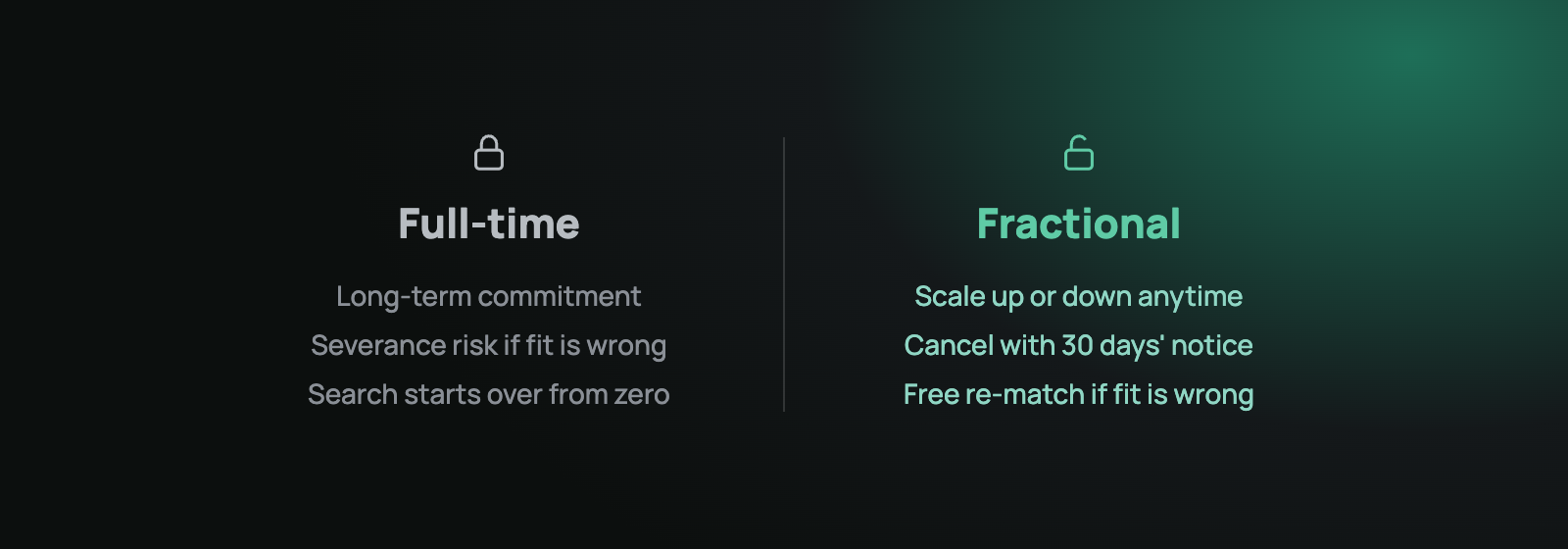
A full-time hire is a long-term commitment. If the fit isn't right, you're looking at a difficult conversation, a severance cost, and starting the search over. A fractional engagement is built to flex: most arrangements can be scaled up or down as workload changes, and canceled with 30 days' notice if it's not working. Olivine will also re-match you with a different consultant at no extra cost if the first fit isn't right, which removes most of the downside risk of trying fractional support in the first place.
5 signs you need a fractional PMM now
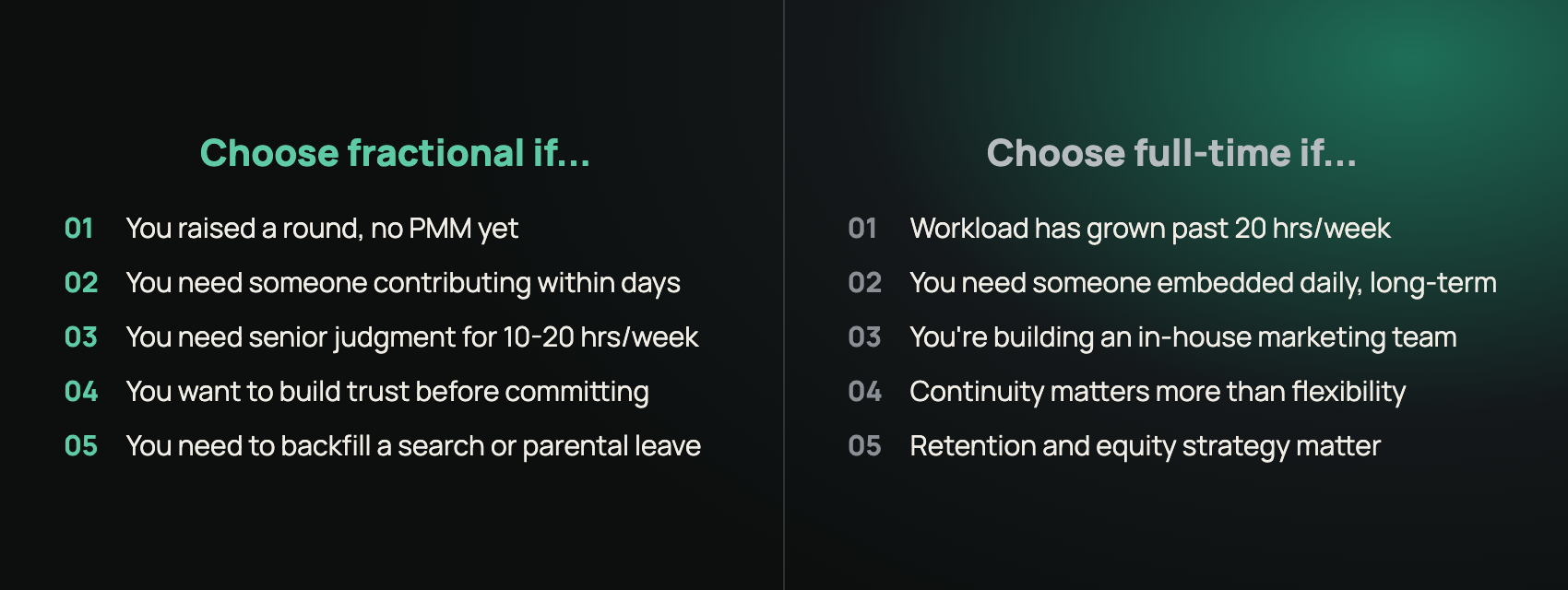
You've raised a Series A or B and don't yet have anyone dedicated to positioning, launches, or sales enablement.
You need someone contributing within days, not after a two to three month full-time hiring process.
You need senior-level judgment, but only have workload or budget for 10 to 20 hours a week of it.
You want to see the work and build trust before committing to a full-time leadership hire.
You need to backfill a gap while a full-time search is already underway or someone is on parental leave.
5 signs you need a full-time PMM instead
Your product marketing workload has grown past what 20 hours a week can realistically cover.
You need someone embedded in daily product and engineering standups long-term, not just for a defined project.
You're building and need to manage an in-house team of marketers.
Your company is scaling fast enough that continuity and institutional knowledge outweigh flexibility.
Retention and equity strategy matter for this specific hire.
Starting fractional, then converting to full-time
You don't have to choose once and live with it. Plenty of companies start with a fractional product marketing manager specifically to de-risk the decision. You get the work done, you see how the person operates inside your team, and if it's clearly working, there is potential to convert them to a full-time hire once the workload justifies it.
Olivine structures its fractional engagements this way on purpose. If a client wants to hire their consultant in-house, it's a straightforward conversion through our product marketing recruitment support, rather than starting a search from zero.
FAQ
Is a fractional product marketing manager as good as a full-time one? Seniority-wise, often more so. Most fractional PMMs are experienced marketers with 8 to 15 years at established tech companies, brought on for the judgment they bring in a limited number of hours. The difference is capacity, not skill.
What's the difference between a product marketing manager and a product manager? A product manager owns what gets built and the product roadmap. A PMM owns how it's positioned, launched, and sold: messaging, sales enablement, and go-to-market strategy. Related, but distinct jobs, and companies sometimes conflate them when scoping a hire.
How many hours a week does a fractional product marketing manager typically work? Most engagements run 5 to 20 hours a week, occasionally up to 40 for companies effectively building a full fractional marketing team. Five hours a week is best for strategic review. Ten to twenty supports real execution, such as launches and sales-enablement content.
What does a fractional product marketing manager cost per month, compared to a full-time salary? It varies by seniority and hours, but a fractional engagement typically runs a small fraction of the annual cost of a full-time hire once salary, benefits, and ramp time are accounted for. That's exactly why it's a common way to get senior PMM support before a company is ready for a full-time leadership hire.
Not sure which path fits your team? Talk to Olivine about hiring a fractional product marketing consultant. We'll match you with a vetted PMM at the hours and experience level your team actually needs, with the option to convert to a full-time hire later.