
How to Gather Competitive Intelligence in B2B SaaS: Three Sources and a One-Week Plan
TL;DR: Competitive intelligence (CI) is the ongoing practice of collecting and analyzing information about your competitors so your team makes better positioning, pricing, product and sales decisions. To gather competitive intelligence in B2B SaaS, work from three sources: what competitors publish, what your reps hear on calls, and what buyers tell you about the decisions they made. Most teams collect plenty from the first source and almost nothing from the other two, which is where the intelligence that moves win rates usually sits.
Your rep is twenty minutes into a second call with a 600-person fintech when the prospect mentions that your main competitor just dropped its per-seat price and started including onboarding for free.
The rep didn't know, so they say they'll check and follow up. The prospect writes something down, and the call never quite recovers.
Afterward, it turns out the information was already inside the company. The competitor changed its pricing page three weeks earlier.
Two other reps heard the same thing on calls the week before and mentioned it in a Slack thread nobody in marketing reads. A closed-lost note from August says "lost on price, they bundled onboarding." Every piece was there, and none of it reached the person on the call.
That's how competitive intelligence fails at most B2B SaaS companies. The research gets done once, usually as a slide deck before a launch, and nobody owns the steady flow of small updates that would have prepared the rep.
This guide covers where B2B competitive intelligence comes from, how to collect it from calls and buyers, what you can research in a single week, where the legal line sits, and how to turn all of it into something your sales team will use.
- Competitive intelligence answers four questions: who you actually compete with, why buyers choose them, what they say about you, and what they're about to do next. Collect only what serves one of them.
- Work from three sources. What competitors publish tells you what they want buyers to believe. What your reps hear tells you what buyers repeat. What buyers decide tells you what actually mattered.
- Use the two-source rule. A claim about a competitor goes on a battlecard once two of the three sources back it.
- Your sales calls are the cheapest source you have. A required competitor field in your CRM and a tracker for competitor names in your call recordings capture most of what reps hear.
- Interview buyers within a month of the decision, including the ones who chose a competitor. They explain the choice better than any feature comparison.
- Spend one week on desk research before anything else. Pricing history, changelogs, job posts, reviews and ad libraries cost nothing and tell you where to aim the interviews.
- Stay on the right side of the line. Public information, your own deals and buyers who choose to talk are fair game. Insiders, confidential documents and pretexts built to extract secrets are off limits.
- Deliver intelligence on a weekly clock, and write every update as the line a rep should use on their next call.
What Is Competitive Intelligence, and What Should It Answer?
Competitive intelligence is information about your competitors that someone in your company can act on.
It covers their positioning, pricing, product direction, sales tactics and customers, collected continuously and turned into decisions about how you sell, price and position against them.
Most teams have done a SaaS competitor analysis at some point, usually a feature grid or a slide comparing five companies.
That analysis is a snapshot taken on one date. Competitive intelligence is the system that keeps the snapshot current, since a competitor's pricing page, packaging and pitch can all change within a quarter.
Useful competitive intelligence research answers four questions. Each one feeds a specific decision, and anything you collect that answers none of them can wait.
| Question | What it feeds | Where the answer usually comes from |
|---|---|---|
| Who do we actually compete with? | Positioning and your competitive set | CRM data and buyer interviews |
| Why do buyers choose them? | Messaging, product priorities, pricing | Buyer interviews and win-loss |
| What do they say about us? | Objection handling and battlecards | Rep feedback, call recordings, mystery shopping |
| What are they about to do? | Launch timing, pricing moves, territory plans | Published sources, job posts, changelogs |
The first question tends to surprise teams. When you look at closed-lost reasons honestly, the competitor you lose to most is often "no decision," a spreadsheet, or a project the buyer decided to build in-house, and none of those appear on your battlecards.
Where Does B2B Competitive Intelligence Come From?
B2B competitive intelligence comes from three places, and each one shows you a different version of the competitor. A program that draws on all three catches what any single source misses.
A) What competitors publish: Pricing pages, changelogs, documentation, job posts, case studies, ads, webinars and the comparison pages they write about you. This source shows you what the competitor wants buyers to believe and where they're investing.
B) What your reps hear: Call recordings, CRM notes, closed-lost reasons, and questions prospects ask about competitors in late-stage deals. This source shows you how the competitor's story lands once a buyer repeats it.
C) What buyers decide: Win-loss interviews, conversations with customers who switched from a competitor, review sites, and mystery shopping. This source shows you what mattered when money was on the line.
| Survives the summary | Gets dropped |
|---|---|
| A category buyers already search for | A category you coined that nobody else uses |
| A named buyer, like "finance teams at 200 to 2,000 person SaaS companies" | "Modern teams" and "forward-thinking companies" |
| A difference someone can check, like "closes month-end in four days" | "Powerful," "intuitive" and "AI-native" |
| Claims your customers repeat in their reviews | Claims only your homepage makes |
| One sentence, used word for word in five places | Five versions of the sentence, one per team |
Crayon's research points the same direction. Its 2025 State of Competitive Intelligence report found that the most effective programs combine web intelligence with insights from buyers, sellers and live deals.
Teams that rely on web monitoring alone end up with a detailed record of what competitors said and very little about what worked.
The three sources also check each other. A competitor's pricing page might announce a new free tier, but you only know it matters once reps hear it in deals and buyers cite it in a loss.
That's the logic behind the two-source rule: before a claim goes on a battlecard, at least two of the three sources should support it.
How Do You Gather Competitive Intelligence From Your Own Sales Calls?
Your own sales calls are the competitive intelligence source most teams underuse, because the information arrives scattered across recordings, CRM fields and Slack threads. The work is mostly plumbing, and you can set most of it up in a week.
1. Make the competitor field required: Add a "primary competitor" field to your opportunity record and require it from the stage where reps usually learn who else is in the deal. Include options for "no decision," "in-house build" and "status quo." Crayon's 2025 report found that 44% of companies lacked competitor visibility in their CRM, which means nearly half can't answer "who do we lose to" with data.
2. Track competitor names in call recordings: If you use a conversation intelligence tool like Gong or Chorus, set up a tracker for each competitor's name, their product names, and common misspellings. Once a month, listen to the five most recent calls where a competitor came up and note what the buyer said about them.
3. Fix the closed-lost reasons: "Price" and "timing" explain almost nothing. Replace the dropdown with a short list that names the real failure modes (lost on packaging, lost on a missing integration, lost at security review, lost to an incumbent) and add a required free-text line.
4. Give reps one place to post what they hear: A single Slack channel with a pinned template works. Ask for four things in every post: the competitor, what the buyer said, the deal name, and the date. Thank people publicly when a post turns into a battlecard update, since that's what keeps posts coming.
5. Ask three questions in pipeline review: Who else is in this deal? What has the buyer said about them? What did they ask us that we couldn't answer? Five minutes a week across a sales team surfaces more than most monitoring tools.
Treat what reps report as a hypothesis rather than a finding. Reps hear the buyer's version of the competitor's story, filtered through a conversation where the buyer is negotiating. That's useful, and it still needs a second source before it changes your messaging.
How Do You Gather Competitive Intelligence From Buyers?
Buyers who just made a decision are the best competitive intelligence sources you have, because they compared you and the competitor side by side with real money at stake. Talk to them while the decision is fresh, ideally within a month of close.
Klue's 2025 Win-Loss Trends Report, based on more than 300 marketing and CI leaders, found that 70% of the deals teams analyze closed within the month before.
The same report found that teams combining win-loss with competitive intelligence were nearly three times as likely to say win-loss had a significant impact on the business.
1. Win-loss interviews. Interview buyers after a decision, won or lost, about how they made it. Prioritize losses to your top two competitors and wins where a competitor reached the final round. Ask what the competitor showed them, what convinced them, and what nearly changed their mind.
2. Switcher interviews: Customers who moved to you from a competitor know that competitor's product better than your team ever will. Ask what made them leave, what they miss, and what the competitor said when they tried to keep them.
3. Review sites: G2, Capterra and TrustRadius let you filter a competitor's reviews by company size and industry. Read the three-star reviews from companies that look like your ICP, since those usually describe a real limitation without the anger of a one-star review.
4. Mystery shopping: Going through a competitor's sales process the way a buyer would shows you their demo, their pricing conversation and how they handle objections about you. Olivine's guide to B2B mystery shopping walks through how to run one from demo request to proposal.
Run buyer interviews the way you'd run any customer research: recruit through the account owner, keep it to 30 minutes, ask about what happened in order, and record with permission. Our guide to B2B market research covers how many interviews you need, what to ask, and how to turn the notes into decisions.
Consider a neutral interviewer for losses. Buyers who chose a competitor soften their answers when the person asking works for the vendor they turned down, and a third party usually gets the less polite and more useful version.
What Competitive Intelligence Research Can You Do in One Week?
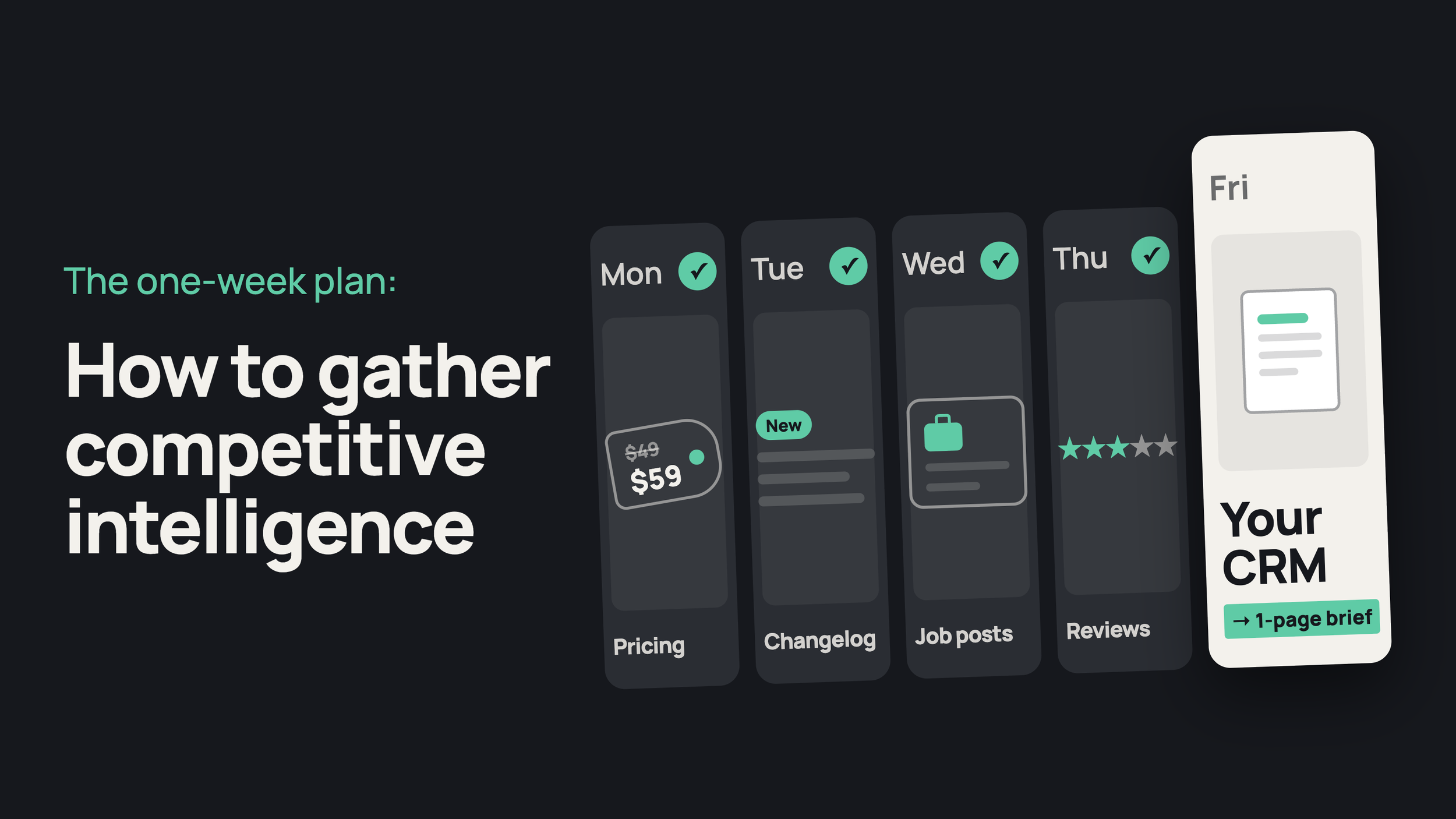
You can do a useful round of competitive intelligence research on one competitor in five working days, using only public sources and your own data. The goal for the week is a one-page brief that names what changed, what buyers say, and what your reps should do about it.
| Day | Source | What to capture |
|---|---|---|
| Monday | Pricing page, packaging and plan limits, plus their history in the Internet Archive's Wayback Machine | What changed in the last 12 months, what moved between plans, what's now an add-on |
| Tuesday | Changelog, release notes, docs, trust or security page | What shipped, what's in beta, which certifications they added |
| Wednesday | Job posts and LinkedIn headcount | Where they're hiring, which regions, which new leaders joined |
| Thursday | Review sites, communities, ad libraries, their comparison pages about you | Buyer language, recurring complaints, the claims they make in ads and about you |
| Friday | Your CRM and the last five call recordings that mention them | Win rate against them, stages where you lose, what buyers repeat |
Some sources earn more attention than they usually get. Job posts often describe the roadmap more candidly than the website does, since a listing for "Senior PM, Enterprise Permissions" tells you what's coming in two quarters.
LinkedIn's Ad Library, Google Ads Transparency Center and the Meta Ad Library show the messages a competitor is paying to test, which is a decent preview of their next homepage.
Read the comparison pages competitors write about you with care. They're the most detailed description of your product anywhere on the web, written by the company most motivated to make it look worse, and your reps' prospects have probably read them.
End the week by writing the brief. Keep it to one page with three sections: what changed, what buyers say, and what reps should say or do differently. If a section is empty, that tells you where next week's interviews should go.
What Is Off Limits When You Gather Competitive Intelligence?
When you gather competitive intelligence, public information, your own deal data, and buyers who choose to talk to you are fair game. Confidential information obtained through improper means is off limits, and so is anything that turns a competitor's employee or a shared customer into a source of their secrets.
US trade secret law is a useful reference point. The federal Defend Trade Secrets Act defines improper means as theft, bribery, misrepresentation, espionage, and breaching or inducing a breach of a duty to keep something secret.
It also says reverse engineering and independent discovery are proper means, which is why studying a competitor's public product and published pricing is ordinary practice.
The line gets tested in B2B SaaS. In March 2025, Rippling sued Deel in federal court, alleging Deel recruited a Rippling employee to pass along confidential information from internal systems.
In February 2026, a federal judge allowed the racketeering and trade secret claims to proceed, and the Wall Street Journal reported in January that the Justice Department had opened an investigation.
Deel has denied wrongdoing and the case is ongoing, but the allegations describe exactly what a competitive intelligence program must never do.
| Fair game | Check with legal first | Off limits |
|---|---|---|
| Public pricing, docs, changelogs, job posts | Recording calls (several US states, including California and Florida, require every party's consent) | Recruiting or paying a competitor's employee for information |
| Reviews, community threads, ads, press | Signing up for a competitor's free trial (many SaaS terms bar competitive use) | Asking a new hire to bring files, decks or pricing from their old employer |
| Your own CRM, call recordings and win-loss data | A competitor's proposal or contract a prospect forwards to you unprompted | Logging in with someone else's credentials or accessing systems you aren't authorized to use |
| Interviews with buyers who know who you are and agree to talk | Mystery shopping, depending on how the buyer profile is presented | Pretexts built to extract trade secrets, internal roadmaps or other customers' terms |
The middle column is where companies set their own policy. Professional standards are stricter than the law in places: the code of ethics from SCIP, the main professional association for competitive intelligence, asks practitioners to disclose their identity and organization before interviews.
Write down where your team draws the line before anyone needs to ask, and treat this section as a starting point rather than legal advice.
New hires from competitors deserve their own rule. Their experience and judgment are part of why you hired them, and you can ask how they think about the market.
Their former employer's documents, customer lists and pricing stay where they were, and saying so in their first week protects them as much as you.
How Do You Turn Competitive Intelligence Into Something Sales Uses?
Competitive intelligence becomes useful to sales once it's translated into what a rep should say or do, and once it arrives on a predictable schedule in a tool reps already open. Most programs collect well and stall here, with a folder of findings that never reaches a live deal.
Crayon's 2026 State of Competitive Intelligence report found that delivery cadence was one of the strongest predictors of revenue impact, ahead of tooling or polish.
The programs pulling ahead get competitive updates to sellers every week, in the tools they already use. The most common gap in the report was the lack of an executive sponsor in sales.
Write each piece of intelligence as an instruction. The examples below are illustrative, written for an invented competitor, and each usable version tells a rep what to do in their next conversation.
| Raw intelligence | Usable intelligence |
|---|---|
| Competitor launched an AI assistant | Their AI assistant is only on the Enterprise plan. If a mid-market prospect brings it up, ask which plan their quote is on. |
| Competitor changed its pricing | Since August, SSO is a paid add-on on their Growth plan. Ask whether security has reviewed the quote before procurement sees it. |
| Reviewers say their onboarding is slow | Four G2 reviews from teams over 200 people describe implementations longer than ten weeks. Offer a reference customer who went live in three. |
| They're hiring in Germany | Six open sales roles in DACH. Expect them in EU deals by Q1, and move the data residency one-pager into the first follow-up email. |
Run competitive intelligence on three clocks so each audience gets what it needs. A weekly digest of three to five changes goes to sales in Slack or email.
Battlecard updates go out whenever a change affects how reps handle a live objection. A quarterly brief goes to leadership and product, covering win rate by competitor and the trends behind it.
The battlecard is where most of this lands. Olivine's guide to competitive battlecards sales reps actually open covers how to structure them around the moments reps need help, and the test it applies is a good one for every piece of intelligence: if a rep wouldn't say the sentence out loud on a call, rewrite it until they would.
Measure whether any of it works. Track win rate against each named competitor, the share of opportunities with a competitor recorded, and how often reps open the battlecards.
If the win rate hasn't moved after two quarters, look at cadence and format first, since that's usually where the program is losing reps.
Pick One Competitor and Three Sources This Week
A full competitive intelligence program can wait until you've proved the first loop works. One competitor, three sources and a one-page brief will show you whether your team has a collection problem, a delivery problem, or both.
1. Pick the competitor you lose to most: Use closed-lost data from the last two quarters. If the CRM can't tell you, ask your three most experienced reps, and add the required competitor field so you can answer from data next quarter.
2. Take one source from each column: For example, their pricing page and its history, the last five call recordings that mention them, and two buyers who chose them in the last 90 days. Book the buyer calls today, since they take longest to schedule.
3. Fill in the four questions: Write down who you actually compete with in those deals, why buyers chose them, what they say about you, and what the competitor appears to be doing next. Mark anything that only one source supports.
4. Write three usable lines: Turn your strongest findings into instructions a rep can use on their next call, following the raw-to-usable pattern above.
5. Ship it on Friday: Post the three lines in the sales channel, update the battlecard, and put a date on the next update. Then check in four weeks whether reps used the lines and whether the win rate against that competitor moved.
Work With Olivine on Competitive Intelligence
If your reps keep learning about competitor moves from prospects, the gap usually sits between the intelligence you already have and the people who need it.
Olivine's competitive intelligence work covers competitor analysis, feature comparisons, secret shopper research, comparison pages, battlecards, and ongoing monitoring.
For Siteimprove, that meant battlecards for competitors across its SEO, accessibility, content and governance product lines, built in a standardized format in Klue so every card matched the go-to-market messaging, with talk tracks reps could use in the pitch and updates as products and competitors changed.
When the work needs to reach the field, it connects directly to Olivine's sales enablement practice.
Visit the competitive intelligence page to see how we work, or get in touch to talk through which competitor to start with.
Frequently Asked Questions (FAQs)
Is competitive intelligence legal? Competitive intelligence is legal when it comes from public sources, your own data and people who choose to share what they know. It crosses the line when it relies on theft, bribery, misrepresentation or breached confidentiality, such as paying a competitor's employee for information. Check gray areas with your legal team.
What is the difference between competitive intelligence and market research? Competitive intelligence focuses on specific competitors: their pricing, positioning, product moves and how they sell against you. Market research studies buyers and markets more broadly, including segments where you have no competitor yet. The two overlap in win-loss interviews, which tell you both why buyers choose and how competitors win them.
Who owns competitive intelligence at a B2B SaaS company? Product marketing usually owns competitive intelligence at a B2B SaaS company, since PMMs also own positioning and battlecards. Sales should have an executive sponsor for the program, and Crayon's 2026 research found that sponsor is the most common gap. Reps contribute field intelligence, and product uses the findings to set roadmap priorities.
How many competitors should you track? Most B2B SaaS teams should track three to five competitors closely and watch the rest lightly. Choose the close set from your closed-lost data, since the competitors you lose to most deserve the most attention. Include "no decision" and in-house builds in that analysis, because they often outrank every named vendor.
How often should you update competitive intelligence? Update competitive intelligence for sales every week, with a short digest of what changed and what reps should do about it. Refresh battlecards whenever a change affects a live objection, and review the full competitive landscape with leadership every quarter. Run deeper research, such as win-loss interviews or mystery shopping, at least once a year.