
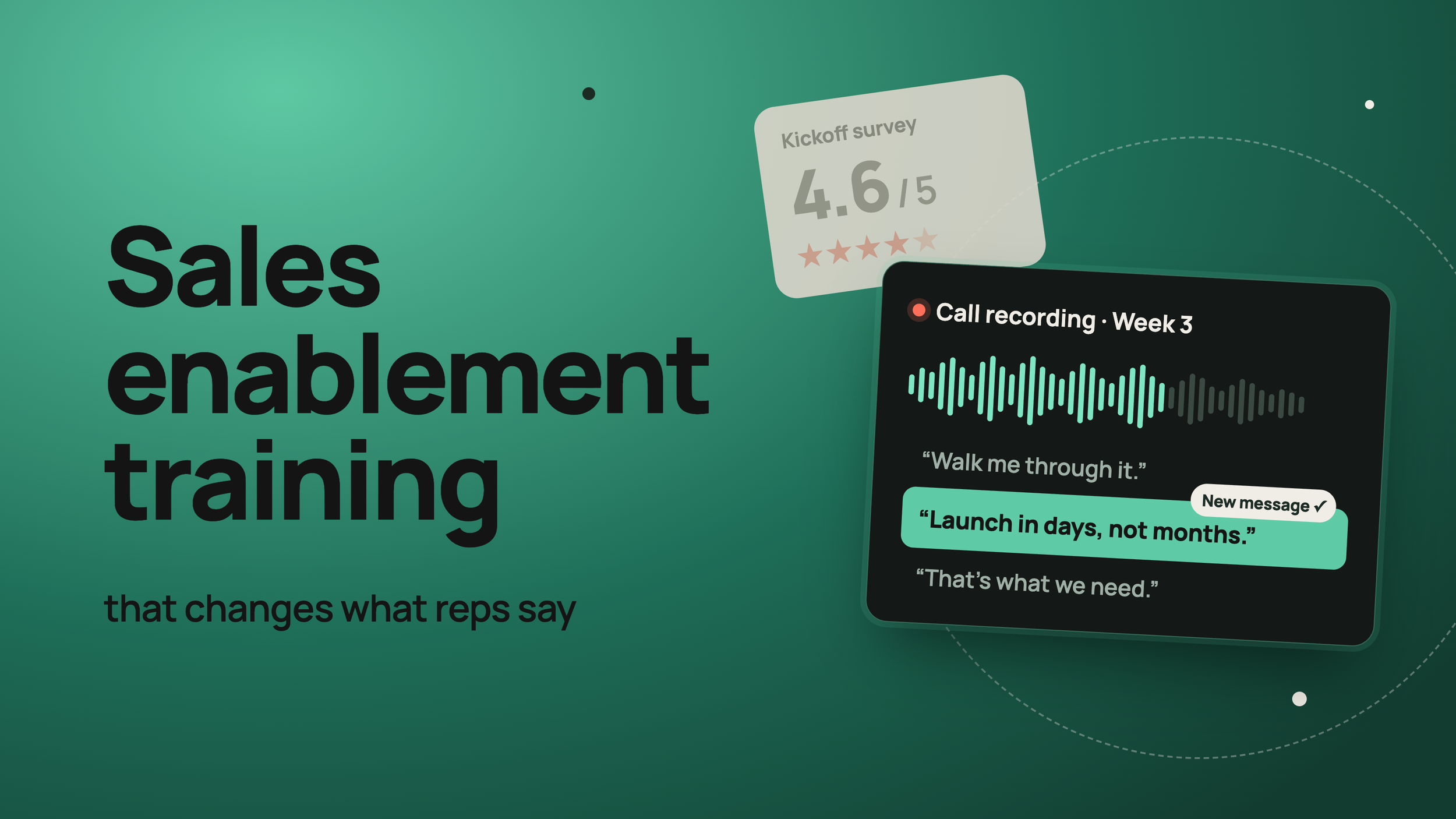
Quick Answer: Sales enablement training is the set of programs that teach reps what to say about your product and how to say it in a live deal. It covers onboarding for new hires, product launch training, sales kickoff sessions, and ongoing practice on messaging and selling skills. Training has worked when reps use the new message on recorded calls weeks later, so every program needs practice, a certification, and a manager who listens afterward.
Your sales kickoff wrapped on Thursday afternoon. Product marketing walked the room through the new positioning, the CRO introduced the platform story, and every rep left with a fresh deck, three value pillars, and a battlecard for the competitor that keeps showing up in late-stage deals. The session survey came back at 4.6 out of 5.
Three weeks later, you pull five discovery calls from your call recorder. Four reps open with the same talk track they used last year. The fifth uses the new pillars in the wrong order, for the wrong persona, and the prospect still asks how you're different from the incumbent.
The kickoff did its job as an event. People listened, learned the new story, and rated the session well. What it didn't include was everything after the event: a round of practice in each rep's own words, a check that they could deliver the message without slides, and a manager listening to calls in the weeks that followed.
This guide covers what sales enablement training is, why most of it fails to change rep behavior, what to cover in onboarding and launch training, how long sales onboarding should take in B2B SaaS, and how to tell whether any of it worked.
It's built around the formats most B2B SaaS teams already run: onboarding, launch training, and the sales kickoff.
- Judge training by calls: Sales enablement training succeeds when reps say the new message on real calls, so look at recorded calls three weeks later instead of survey scores.
- Most training fails because it ends when the session ends: Practice, certification, and manager review are where behavior changes.
- Teach less: Pick the three things you most want to hear on calls and build every module around them.
- Launch training runs on a short cycle: It starts with a message locked two to three weeks before the session and ends with a call review about two weeks after launch.
- Onboarding needs a 90-day plan: Plan a structured program and expect full productivity to take longer, since AE ramp averaged 6.2 months in The Bridge Group's 2026 research.
- Use the three-week test: If the new message isn't on recorded calls three weeks after training, retrain, rewrite the line, or fix the asset.
- Bring in help for spikes: Outside help fits kickoffs, repositioning, big launches, and first onboarding builds, while weekly coaching stays with your managers.
Key Takeaways
Judge training by calls - Sales enablement training succeeds when reps say the new message on real calls, so look at recorded calls three weeks later instead of survey scores.
Most training fails because it ends when the session ends - Practice, certification, and manager review are where behavior changes.
Teach less - Pick the three things you most want to hear on calls and build every module around them.
Launch training runs on a short cycle - It starts with a message locked two to three weeks before the session and ends with a call review about two weeks after launch.
Onboarding needs a 90-day plan - Plan a structured program and expect full productivity to take longer, since AE ramp averaged 6.2 months in The Bridge Group's 2026 research.
Use the three-week test - If the new message isn't on recorded calls three weeks after training, retrain, rewrite the line, or fix the asset.
Bring in help for spikes - Outside help fits kickoffs, repositioning, big launches, and first onboarding builds, while weekly coaching stays with your managers.
What Is Sales Enablement Training?
Sales enablement training is the set of programs that prepare customer-facing teams to sell your product: onboarding for new hires, training on each product launch, sales kickoff sessions, and recurring practice on messaging and selling skills.
It teaches your company's way of selling, including positioning, personas, competitive differentiation, and objection handling, and it is judged by what reps do in deals afterward.
Generic sales training teaches skills that apply anywhere, such as discovery, negotiation, or a named sales methodology.
Sales enablement training starts from your positioning and teaches reps to deliver it to your buyers, against your competitors, with your proof. Most B2B SaaS teams need both, and the second kind is the one that slips first after a launch or a repositioning.
Our earlier guide to what sales enablement is splits the function into three pillars: onboarding, ongoing training, and process and tooling. Training covers the first two, and it usually comes in four forms.
| Training type | When it happens | Who it's for | What reps should be able to do afterward |
|---|---|---|---|
| Onboarding | The first 90 days after a hire | New AEs, SDRs, and sales engineers | Run a first call on their own using the core pitch |
| Product launch training | Before each tier 1 or tier 2 launch | Every rep who will sell the release | Pitch the launch to their main persona in under two minutes |
| Sales kickoff | Once or twice a year | The whole revenue team | Open calls with the new positioning and platform story |
| Ongoing messaging and skills practice | Monthly | Reps and their managers | Handle the top objections and competitors with current answers |
Who builds each program, and who presents the product content inside it, depends on how your company splits the work between enablement and product marketing. We covered that split asset by asset in sales enablement vs. product marketing.
Why Does Most Sales Training Fail to Change Rep Behavior?
Most sales training fails to change rep behavior because it is planned as an event and measured as one. The session gets the budget, the agenda, and the survey, while practice, certification, and follow-up get whatever time is left.
Reps hear the new message once, go back to a full pipeline, and fall back on the talk track that closed their last deal.
Reps say as much themselves. In Salesforce's State of Sales report, a survey of 4,050 sales professionals in 22 countries run in late 2025, 52% of reps said traditional enablement doesn't give them the skills they need.
Nearly half (46%) said they rarely get feedback on their sales conversations, 41% said they don't get enough chances to role-play before customer calls, and 40% named their manager's lack of time as an obstacle. Three in four said they'd be more likely to hit their targets with a coach or mentor.
Gartner's research on making sales training sticky reaches the same conclusion from the trainer's side: sellers begin forgetting what they learned right after a session, so product marketers who lead or support training need to keep reinforcing it and check that reps apply it.
You may have seen a statistic claiming reps forget 84% of training within 90 days. The number is repeated everywhere, but nobody seems to have traced it to an actual study, and five recorded calls from three weeks after your last kickoff will tell you more than any benchmark.
Four patterns show up in most training that doesn't stick. Each one comes from treating the session as the finish line:
Too much in one sitting - A two-day kickoff with twelve sessions asks reps to absorb a year of changes at once, and they keep only the parts they need that month.
Slides in place of practice - Reps watch someone else deliver the pitch and never say it out loud in their own words before a buyer hears it.
No proof before the field - Without a certification step, nobody knows who can deliver the message until a prospect hears the wrong version.
Nobody listening afterward - Managers run deal reviews on numbers and next steps, so the new message never comes up again.
| Training run as an event | Training that changes what reps say | |
|---|---|---|
| Unit of work | A session | A cycle: learn, practice, certify, and review |
| Content | Everything that changed this quarter | The three things you want to hear on calls |
| Practice | An optional role-play at the end, if time allows | Every rep records their own version before launch |
| Proof | Attendance and a quiz | A recorded pitch scored against a short rubric |
| Measured by | Survey scores | What reps say on calls three weeks later |
| Done when | The session closes | The new message shows up on calls without prompting |
The last row is the standard we hold training to. The three-week test: training worked if, three weeks later, reps use the new message on recorded calls without being prompted. If they don't, you find out before the quarter ends, with time left to fix the training, the asset, or the message itself.
What Should Sales Enablement Training Cover?
Sales enablement training should cover four areas: the message, the market, the motion, and the tools. The message is your positioning, value pillars, and the problems each persona cares about.
The market is your competitors and how buyers compare you. The motion is your sales process and selling skills, and the tools are the systems reps use to find content and manage deals.
| Area | What reps should be able to do | Usually taught by |
|---|---|---|
| The message | Explain the product in one sentence, match a value pillar to each persona, and back each claim with proof | Product marketing |
| The market | Name the top three competitors, say where you win and lose, and answer the comparison question | Product marketing, using battlecards |
| The motion | Run discovery, qualify, and move deals between stages the way your team does | Enablement and sales leadership |
| The tools | Find the current deck and battlecards in under a minute, and update deals the way managers need | Enablement and revenue operations |
Keep each program narrow. A launch session might cover only the message and the market for one release, while onboarding works through all four areas in order. A good test for any module is whether a rep would say its content out loud on a call, the same rule behind our guide to competitive battlecards sales reps actually open.
Before you build anything, write down the three sentences you most want to hear on calls after the training. Every slide, exercise, and certification question should trace back to one of them, and anything that doesn't can go in a reference doc reps read on their own time.
How Do You Train Reps on a Product Launch?
Product launch training for sales works best as a short cycle around launch day. Lock the message two to three weeks before training, send a self-paced pre-read, run a live session with product marketing presenting, have every rep record a practice pitch, certify before launch, and review real calls about two weeks after. Reps should finish able to pitch the release to their main persona in under two minutes.
| When | Step | Owner | Output |
|---|---|---|---|
| Two to three weeks before training | Message lock | Product marketing | A final launch brief covering what's new, who it's for, why it matters, and what changes for reps |
| One week before training | Pre-read | Enablement | A short self-paced module with features, pricing, and FAQs |
| Training day | Live session, 45 to 60 minutes | Enablement runs it, and product marketing presents | Reps hear the story and ask questions only the message owner can answer |
| Within three days | Practice round | Reps, with their managers | A recorded two-minute pitch to each rep's main persona |
| Before launch | Certification | Enablement and managers | Each pitch scored against three or four criteria |
| About two weeks after launch | First call review | Managers, with product marketing | Five call clips reviewed and one fix chosen |
Live time should go to the story and the questions. Put feature lists, pricing details, and setup steps in the pre-read, so the session can focus on why the release matters to each buyer and how it changes the conversation. Product marketing should present that part, since reps will ask about edge cases and competitors that only the message owner can answer.
The practice round and certification are the steps teams cut first when a launch date slips, and they're the steps that change behavior. A recorded pitch scored on a few criteria (opens with the buyer's problem, names the right value pillar, uses one proof point, and handles the likeliest objection) takes a manager about five minutes per rep. It also shows exactly who needs a second pass before a prospect hears the pitch.
Two of the launches in our roundup of launching products that win show the pattern. Klaviyo trained its sales team to lead with how its new SMS product worked alongside its email product when competing against Attentive. Experian's Aperture Data Studio launch paired sales plays and collateral built on clear differentiators with an internal campaign that kept global teams aligned.
Training Reps at a Sales Kickoff
A sales kickoff is launch training at full scale, often with new positioning, a platform story, and several releases on one agenda.
Give the core message one block early on day one, use breakouts for practice by segment or persona, and put the first certification and call reviews on the calendar for the weeks after, when reps are back on calls.
Finish the enablement materials well before the event, so kickoff time goes to practice instead of last-minute slide changes.
How Long Should Sales Onboarding Take in B2B SaaS?
Sales onboarding in B2B SaaS should run as a structured 90-day program, with full productivity arriving later. The Bridge Group's 2026 AE research, based on 158 B2B companies, put average AE ramp time at 6.2 months, the highest in the study's history. Sales cycles set part of that number, and onboarding decides how much of the first quarter new reps spend selling well.
| Phase | Focus | Proof before moving on |
|---|---|---|
| Weeks 1 and 2 | Product, market, personas, and the core pitch | Deliver the core pitch to a manager without slides |
| Weeks 3 and 4 | Competitors, discovery, and shadowing live calls | Pass a discovery role-play scored on the team's rubric |
| Days 31 to 60 | Running first calls with a manager or peer listening | Two recorded calls reviewed against the scorecard |
| Days 61 to 90 | Owning deals, handling objections, and building pipeline habits | First opportunities created and a call review with the manager |
The order matters more than the exact dates. New reps should say the core pitch out loud within the first two weeks, because the sooner they practice it, the less time they spend building their own version from old decks and shadowed calls.
Product marketing usually teaches the message and market modules, and enablement owns the sequence and the bar for moving on.
Ramp also depends on the market reps are selling into. The same Bridge Group research found that 48% of reps hit their annual quota in 2026, down from 51% in 2024, which makes a new hire's first quarter more expensive than it used to be.
Onboarding that ends with a certified pitch and reviewed calls lets managers spot a slow ramp in month two instead of month six.
How Do You Know Sales Training Worked?
You know sales training worked when reps use the new message on real calls and the deals they run with it move differently.
Survey scores and quiz results show that reps liked the session and remembered it. Sales training effectiveness shows up in call recordings a few weeks later, and then in stage conversion, win rate, and ramp time over the following quarter.
Many teams already use the Kirkpatrick model, which measures training at four levels: reaction, learning, behavior, and results.
Sales teams tend to report the first two because they're easy to collect, and the reporting often stops there. The three-week test sits at level three, where training starts to pay off.
| Level | Question | How to measure it in a sales team | When |
|---|---|---|---|
| Reaction | Did reps find it useful? | Session survey | Same day |
| Learning | Do reps know the message? | Certification, using a recorded pitch scored on three or four criteria | Within a week |
| Behavior | Do reps say it on calls? | Call review with a short scorecard, five calls per team | Three weeks after |
| Results | Do those deals go better? | Stage conversion, win rate, and deal size on deals that used the new message, compared with similar deals that didn't | One to two quarters |
Keep the scorecard short enough that a manager can fill it in while listening. Three or four yes-or-no questions work well: did the rep open with the buyer's problem, use the value pillar for that persona, back it with proof, and handle the most common objection with the current answer? Track the share of calls that hit each one, and you'll see which part of the message didn't land.
Read results carefully. Win rates move for many reasons, so compare similar deals in the same quarter instead of this quarter against the last one.
For onboarding, track time to first opportunity and time to first closed deal by hiring cohort, which shows whether a change to the program helped the next group of hires.
When Should You Bring in Outside Help for Sales Training?
Bring in outside help for sales training when the work spikes past what your team can build, or when the message itself is changing.
Sales kickoffs, repositioning, a new product line, and a first onboarding program are the usual triggers. Keep weekly coaching and call reviews in-house, since they depend on managers who sit with the team every week.
The signs that outside help would pay off are usually visible on the calendar before anyone asks for it. Look for these:
A kickoff with nobody to build it: A kickoff or launch is on the calendar, and nobody is free to build the materials, the practice rounds, and the certification.
Positioning the field hasn't absorbed: The positioning changed months ago, the website reflects it, and reps still open with the old pitch.
A first onboarding program: You're building a first onboarding program, or the team has grown past the point where new hires can learn by shadowing.
A PMM team that needs the frameworks: Your product marketing team needs the frameworks too. Training the people who write the message often fixes problems that would otherwise surface in sales training later.
At Olivine, training usually sits next to the materials it teaches. Before Darktrace's annual sales kickoff, our team ran persona and jobs-to-be-done workshops across its product portfolio, then built the value propositions, use cases, battlecards, and two-pagers reps would sell with.
For LinkedIn's B2B product marketing team, we led Jobs To Be Done and Story-First Product Development workshops, and the team kept the recordings, slides, templates, and Miro board so leaders could reinforce the frameworks after the sessions ended.
Whoever runs your training, ask what stays behind when it's over. You should end up with editable materials, a certification rubric, a call review scorecard, and recordings, so your managers can keep the reinforcement going. Olivine's sales enablement training programs are built to hand those over.
Replace One Session With a Call Review This Month
You don't need a new program to start. Take one training slot on this month's calendar and spend it listening to calls instead.
1. Pick the message you trained most recently - Choose the last launch or kickoff theme, and write down the three sentences you hoped reps would say afterward.
2. Turn those sentences into a scorecard - Write three or four yes-or-no questions, one for each sentence plus the most common objection, and keep it to a single page.
3. Pull five calls from the last two weeks - Choose calls with the persona the message was written for, from at least three different reps, so one strong rep doesn't skew the picture.
4. Review them together for 30 minutes - Bring a sales manager and someone from product marketing, score each call, and note where the message held and where reps went back to the old talk track.
5. Fix one thing and book the next review - Retrain a single point, rewrite a line reps keep avoiding, or update the asset they're still using, then put the next call review on the calendar for a month out.
Run it once, and you'll know whether your last training passed the three-week test. Run it every month, and it becomes the reinforcement most training plans leave out.
Work With Olivine on Sales Enablement Training
If your reps leave training with good survey scores and the same talk track, the fix usually involves both the message and the way reps practice it.
Olivine's sales and marketing training covers sales enablement training on your messaging and positioning, product marketing training for the team that writes the message, remote programs for distributed teams, and in-person workshops.
Programs range from a single workshop to multi-session engagements over several weeks, built around the positioning and assets your reps already use.
Visit the training page to see how we work, or get in touch to plan your next launch or kickoff with us.
Frequently Asked Questions (FAQs)
How often should you run sales training? Run sales training on a monthly rhythm, with one short session or call review each month, launch training for every tier 1 or tier 2 release, and a sales kickoff once or twice a year. Small, frequent sessions with practice hold up better than one large annual event, because reps keep what they use on calls.
What is the difference between sales training and sales enablement? Sales training is one part of sales enablement. Training teaches reps knowledge and skills through onboarding, launch sessions, kickoffs, and workshops. Sales enablement is the wider function that also covers content, tools, coaching programs, and reporting, so reps can find what they learned and use it in live deals. Enablement also tracks whether training shows up on calls.
Who should deliver product training to sales? Product marketing should deliver the product and market content in sales training: positioning, personas, competitive claims, and the story behind each launch. Product managers can cover technical depth for sales engineers. Enablement designs the session, runs the practice round, and owns certification, and a top rep showing how they pitch the release makes the session more credible.
Should sales training be live or self-paced? Sales training works best as a mix of both. Use self-paced modules for knowledge reps can read on their own, such as feature details, pricing, and process steps. Save live time, remote or in person, for the story, questions, and role-play, since practice with feedback is what changes how reps sound on calls.
How do you get reps to use new messaging after training? Get reps to use new messaging by giving them fewer lines to learn, having them practice in their own words, and certifying with a recorded pitch. Update the deck, talk tracks, and battlecards on the same day, and ask managers to score calls on the new message for the next month. Reps repeat what their managers listen for.