
Sales Enablement vs. Product Marketing: Who Owns What
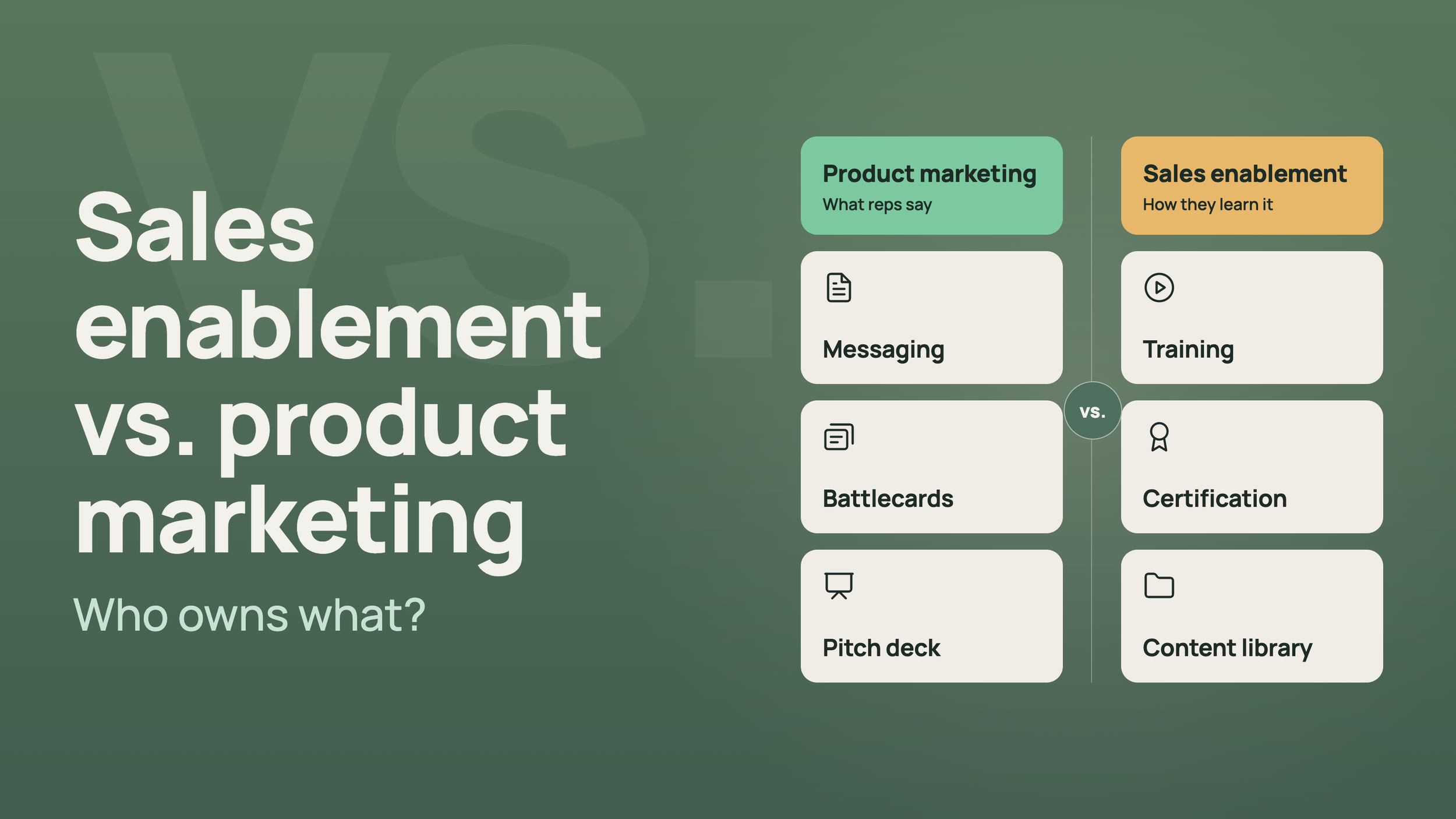
TL;DR: The difference between sales enablement and product marketing comes down to the question each team answers. Product marketing decides what your company says about the product: positioning, messaging, competitive claims and the story behind each launch. Sales enablement decides how reps learn to say it and keeps them selling well over time, through onboarding, training, certification, coaching and a content library they can search. The two teams share most launch assets, so ownership has to be settled asset by asset.
It's the Tuesday of launch week. Product marketing published the final messaging doc on Friday, with new positioning, three value pillars and a sharper line on why buyers should switch from the incumbent.
Enablement built the training module the week before, working from a draft of the same doc, and ran the live session on Monday morning.
By Wednesday, two reps on the same team are pitching the launch two different ways.
One uses the pillars from the training deck, two of which were renamed in the final edit. The other pulls slides from last quarter's pitch deck, because the new one isn't in the content library yet.
A prospect who has taken calls with both asks which version is correct.
Nobody on either team did bad work. Product marketing wrote a good message and enablement built a good course, but nobody decided who owned the version reps would actually use, or when it had to be final.
This guide covers the difference between sales enablement and product marketing, who owns which asset, where the handoff breaks, and how to map ownership for your next launch.
- Product marketing owns what reps say. Positioning, messaging, competitive claims, pricing rationale and launch stories start with product marketing.
- Sales enablement owns how reps learn to say it. Onboarding, launch training, certification, selling skills and a findable content library sit with enablement.
- Sales managers own whether it sticks. Reinforcement happens in deal reviews and call coaching, which only managers run every week.
- Give every asset one owner. Battlecards, decks and training all have contributors from both teams, and two owners is how two versions of the pitch reach the field.
- Most handoffs break in three places: messaging locks too late for training, copies of the same asset drift apart, and what reps hear on calls never reaches the people writing the message.
- Shared dates matter more than reporting lines. Enablement usually reports into sales, and that works when both teams plan launches from one calendar.
- An agency helps with spikes. Launches, kickoffs, repositioning and first-time builds can outgrow a small team, while weekly coaching belongs in-house.
What Is the Difference Between Sales Enablement and Product Marketing?
Product marketing is responsible for how the market understands your product, and sales enablement is responsible for how well your reps can sell it.
Product marketing works outward, toward buyers. Sales enablement works inward, toward the people who talk to buyers every day, and its scope often grows to include customer success and partner teams.
| Product marketingWhat reps say | Sales enablementHow they learn it | |
|---|---|---|
| Core question | What do we say, to whom, and why is it true? | How do reps learn it, find it and use it in deals? |
| Main audience | Buyers, reached through sales, the website and campaigns | Reps, sales managers, sales engineers and often customer success |
| Core outputs | Positioning, messaging, competitive intelligence, launch plans, pricing narrative, proof | Onboarding, launch training, certification, skills training, coaching programs, content library |
| Usually reports to | Marketing leadership, sometimes product | Sales or revenue leadership |
| Measured on | Win rate, launch pipeline, message adoption in deals | Ramp time, certification, content use, quota attainment |
| Works on the clock of | Launches and market changes | The rep lifecycle, from first week to promotion |
The overlap between the two is large, and in many companies one team covers both.
In the Product Marketing Alliance's 2025 State of Product Marketing report, nearly 79% of product marketers listed sales enablement as a core part of their job. That works as long as everyone knows which part of each asset they own.
The what, how and whether split.
A useful way to divide the work has three parts. Product marketing owns what reps say: the claims, the story and the proof behind them.
Enablement owns how reps learn to say it: the onboarding, practice, certification and tools that turn a messaging doc into a habit.
Sales managers own whether it sticks, because reinforcement happens in deal reviews and call coaching, and managers are the only people in those rooms every week.
Most ownership problems start when one of the three goes missing. A team with strong product marketing and no enablement ships sharp messaging that reps paraphrase badly.
A team without manager reinforcement gets both right in week one and loses them by week six.
What Does Product Marketing Own in Sales Enablement?
In sales enablement, product marketing owns the source material and its accuracy. That covers positioning, the messaging framework, persona insight, competitive claims, pricing and packaging rationale, and the proof behind every claim.
When any of those change, product marketing is responsible for saying so, and enablement should be able to treat the latest messaging doc as the one version to train on.
Positioning and messaging - Product marketing writes the value pillars, the one-line product description and the language reps use with each persona. Our guide to messaging your sales team will actually use covers how to write it so reps can repeat it on a call.
Competitive claims - Product marketing decides what you say about each competitor and keeps those claims current. The intelligence behind them comes from public sources, rep feedback and buyer interviews, which our guide on how to gather competitive intelligence walks through step by step.
Persona and buyer insight - Product marketing knows what each buyer cares about, which objections come up at which stage, and what tips the decision. Enablement turns that knowledge into discovery questions and role-plays, and the research underneath is product marketing's.
Launch content - For every release, product marketing writes what's new, who it's for, why it matters and what changes for reps. That brief is the input enablement needs before it can build any training.
Proof - Case studies, customer quotes and ROI stories come from product marketing, with sales helping to find customers willing to talk. Reps use proof they can say in one sentence, so product marketing should write it that way.
Product marketing also owns the accuracy check on what enablement builds. A short review of training slides and certification scripts before they go live catches renamed pillars and retired claims, and it takes about an hour.
Messaging that's written mostly for the website and never adapted for calls tends to stall before it reaches a rep, a gap we covered in our article titled why brand messaging never makes it to sales conversations.
What Does the Sales Enablement Team Own?
The sales enablement team owns rep readiness. Sales enablement roles and responsibilities usually include onboarding new hires, training reps on launches and selling skills, certifying that they can deliver the message, running the content library, designing the coaching programs managers use, and reporting on whether any of it changed performance.
Enablement is accountable for the gap between what product marketing published and what reps can actually do on a call.
Onboarding and ramp - Enablement designs the path from a rep's first day to their first deal, including which product, market and process modules they complete and in what order. Product marketing teaches some of those modules, and enablement owns the sequence and the bar for completion.
Launch training and certification - Enablement turns the launch brief into a live session, a practice round and a short certification, such as a recorded pitch scored against the new messaging. Certification is the step teams skip most often, and it's the only one that shows whether reps can deliver the message without notes.
Selling skills - Discovery, qualification, negotiation and your sales methodology belong to enablement. These skills change slowly and apply to every product, so they sit with the team that trains reps all year.
Content management - Enablement decides where content lives, how reps find it and when old versions come down. A library holding three versions of the pitch deck is an enablement problem, even when product marketing wrote all three.
Coaching programs - Enablement builds the call review scorecards and coaching guides that managers use with their teams. Managers do the coaching, and enablement makes sure they're coaching to the current message.
Tools and reporting - The enablement platform, the learning system and the analytics behind them usually sit with enablement. So does the report that connects training and content use to ramp time and win rate.
The role keeps widening. In the Sales Enablement Collective's 2024 Landscape Report, 60% of respondents said sales enablement described their job title, but only 37% said it described their day-to-day work, and half described their role as revenue or go-to-market enablement.
As enablement takes on customer success and partner teams, a clear message owner on the product marketing side matters more.
Who Owns Battlecards, Pitch Decks and Sales Training?
Product marketing owns battlecards and the master pitch deck, and sales enablement owns sales training.
Each of those assets has contributors from both teams, which is exactly where launches go wrong.
Give every asset one owner, the person who decides what goes in and when it changes, and list everyone else as a contributor.
| Asset | Owner | Contributors | Why it sits there |
|---|---|---|---|
| Messaging framework | Product marketing | Sales leaders and enablement review | Every other asset borrows its claims |
| Master pitch deck | Product marketing | Enablement adds speaker notes; top reps test drafts | The story has to match the messaging word for word |
| Competitive battlecards | Product marketing | Reps send field intel; enablement trains on them | Each claim needs a source and someone who updates it |
| One-pagers, solution briefs, case studies | Product marketing | Sales finds customers; enablement files them | Buyers read these, so the message owner writes them |
| Objection handling guide | Product marketing | Enablement turns it into role-plays | The answers are claims, and claims need one owner |
| Talk tracks and discovery guides | Sales enablement | Product marketing supplies messaging and persona insight | They follow how reps actually run a call |
| Launch training and certification | Sales enablement | Product marketing presents product content and checks accuracy | Enablement owns how reps learn |
| Onboarding program | Sales enablement | Product marketing teaches product and market modules | Enablement owns the sequence and the completion bar |
| Content library | Sales enablement | Product marketing tags and retires its own assets | Findability is a readiness problem |
| Call coaching scorecard | Sales enablement | Managers use it; product marketing sets the message criteria | Coaching happens in sales, guided by enablement |
The pitch deck and battlecards cause the most arguments, because enablement often has the closer relationship with reps and a better sense of what works on a call.
That knowledge belongs in the asset, as a contribution. Enablement and two or three top reps should test a draft deck before launch and send back what they'd change, and product marketing makes the call and owns the version that ships.
Battlecards follow the same rule. Our guide to competitive battlecards sales reps actually open covers how to structure them around the moments reps need help, and the structure only holds up when one person is accountable for keeping each card current.
Sales training splits the other way. Product marketing should present the product and market content in a launch session, since reps ask questions only the message owner can answer. Enablement still owns the session, the practice round and the certification that follows.
Where Does the Handoff Between Product Marketing and Sales Enablement Break?
The handoff between product marketing and sales enablement usually breaks in three places: timing, versions and feedback.
Messaging locks too late for training, copies of the same asset drift apart, or what reps hear on calls never makes it back to the people writing the message. Each break has a simple fix, and each fix needs an owner.
2. Versions - Enablement copies messaging into training slides, reps copy slides into their own decks, and a month later there are five versions of the pitch. The fix is one master version of each asset, held by the owner in the table above. Training links to the master, and the old version comes out of the content library on launch day.
3. Feedback - Reps hear which claims land and which get pushback, and that information rarely reaches product marketing in a form it can use. Enablement is closest to it through call reviews and certification, and product marketing is the team that rewrites the message. The fix is a monthly 30-minute review where enablement brings five call clips and product marketing decides what changes.
| Where it breaks | What you see | The fix |
|---|---|---|
| Timing | Training built on a draft; reps learn renamed pillars | A message lock date two to three weeks before training |
| Versions | Several decks in circulation; prospects hear different stories | One master per asset; old versions removed on launch day |
| Feedback | The same objection on every call, unchanged messaging | A monthly call clip review with both teams |
The feedback break is the one that hurts quietly.
The Sales Enablement Collective's 2024 survey asked enablement professionals which team they most wanted a better relationship with, and product marketing came up for 10% of them, behind sales management, product, the C-suite and marketing.
A standing review gives that relationship a regular place to happen. For how the two teams work together beyond launches, read our earlier conversation on how product marketing and sales enablement work together.
Should Product Marketing and Sales Enablement Report to the Same Leader?
Product marketing and sales enablement rarely report to the same leader, and they don't need to.
Enablement most often sits under sales or revenue leadership, and product marketing sits under marketing or, at some companies, product.
The reporting line matters less than three shared agreements: one launch calendar, one sign-off process for messaging, and at least one metric both teams answer for.
The question of who owns sales enablement on the org chart has been settling toward sales for years.
A 2025 Forrester data snapshot found enablement functions in high-performing sales organizations are 75% more likely to report to sales or operations leadership.
The Sales Enablement Collective's 2024 survey adds a detail: teams reporting directly to a C-suite executive rated enablement's value highest of any group.
| Company stage | Typical setup | What to watch for |
|---|---|---|
| Early, under about 20 reps | Product marketing runs enablement, often one person doing both | Launches win every scheduling fight, and onboarding slides |
| Growth, about 20 to 100 reps | First enablement hire, reporting to sales | Enablement rewrites messaging to fill gaps product marketing left |
| Scale, 100+ reps or several products | Enablement team under a CRO or revenue operations; product marketing team under the CMO | Versions multiply across segments, regions and product lines |
The early-stage setup needs a guardrail. When product marketing owns enablement, the next launch always feels more urgent than onboarding, and new reps ramp on whatever deck they can find.
Protect a fixed block of time each month for enablement work, and plan the first enablement hire for the point where training keeps losing to positioning work.
When Does a Sales Enablement Agency Make Sense?
A sales enablement agency makes sense when the work spikes past what your team can carry, or when nobody owns enablement yet.
Launches, sales kickoffs, a repositioning, a new product line after an acquisition and a first enablement build are the usual triggers.
Weekly coaching and reinforcement are better kept in-house, since they depend on someone who sits with the sales team every week.
Team size is usually the constraint. The Product Marketing Alliance's 2025 report found that 44.3% of product marketing teams are still one or two people, and those teams carry positioning, launches and enablement at once. Signs that outside help would pay off:
A date with no time behind it: You have a launch or kickoff on the calendar and nobody free to build the deck, battlecards and training around it.
Enablement keeps losing to launches: Product marketing is one or two people, and onboarding has been "next quarter" for three quarters.
The field still sells the old story: You repositioned months ago, and reps still open with the old pitch because nobody rebuilt their assets.
Several products, one rep each: You now sell a platform, and every rep pitches the product they were hired to sell.
A first enablement hire on the way: You want the core assets in place before that person starts, so their first quarter goes to training and coaching.
What the agency hands over matters as much as what it builds.
Expect a messaging framework your team can edit, the assets built on it, the training to launch them, and a named owner on your side for each asset once the engagement ends.
Olivine's sales enablement agency work is set up that way, and if an agency leaves without that ownership map, the handoff problem has only moved.
Map One Launch This Week
You don't need a reorg to fix ownership. Take your next launch and map it, and most of the gaps will show up in an afternoon.
1. Pick the next launch that touches sales - Choose one with a date in the next six weeks, so the map gets used straight away. A tier 1 or tier 2 launch works best, since smaller releases rarely need new training.
2. List every asset a rep will touch - Include the deck, battlecards, one-pagers, email templates, the training session, certification and the content library entry. Most teams find two or three assets nobody planned for.
3. Name one owner per asset - Use the what, how and whether split: product marketing for what reps say, enablement for how they learn it, managers for whether it sticks. Write contributors next to each owner, and leave no asset with two owners.
4. Set three dates - Put a message lock date, a training date and a first call review after launch on one calendar both teams can see. If the lock date falls less than two weeks before training, move one of them now.
5. Book the feedback session - Thirty days after launch, enablement brings five call clips and product marketing decides what to change. Put it on the calendar before launch week, while everyone still agrees it matters.
Work With Olivine on Sales Enablement
If your reps keep pitching two versions of the same launch, the fix usually starts before training, with a message one team owns and every asset shares.
Olivine's sales enablement work for B2B SaaS teams covers pitch decks, battlecards, personas and one-pagers, along with training for sales and marketing teams.
Engagements start with positioning and messaging workshops, so every asset reps use is built on the same story and has a clear owner when we hand it over.
Visit the sales enablement page to see how we work, or get in touch to map your next launch with us.
Frequently Asked Questions (FAQs)
Does sales enablement report to sales or marketing? Sales enablement reports to sales or revenue leadership at most B2B companies, and Forrester research links that setup to high-performing sales organizations. Some companies place enablement in marketing, usually when product marketing started the function. Either works when enablement and product marketing share one launch calendar and agree on how enablement is measured.
Can product marketing run sales enablement without an enablement team? Product marketing can run sales enablement without an enablement team, and many companies start that way. Keep the scope small: a master pitch deck, battlecards for your top competitors, launch training and a simple onboarding path. Plan a dedicated enablement hire once training and onboarding keep losing time to positioning and launch work.
What does a sales enablement agency do? A sales enablement agency builds the assets and programs that prepare reps to sell, such as messaging, pitch decks, battlecards, personas, one-pagers, onboarding content and launch training. Agencies that start from positioning keep every asset on one story. They help most around launches, sales kickoffs, repositioning and a company's first enablement build.
Who writes sales collateral, product marketing or enablement? Product marketing writes buyer-facing sales collateral, such as pitch decks, one-pagers, solution briefs and case studies, because those carry the messaging. Enablement writes rep-facing material, such as talk tracks, training modules, certification scripts and call guides, and makes all collateral easy to find. Each piece needs one named owner who approves changes.
How do you measure sales enablement? Measure sales enablement with readiness and revenue metrics together: ramp time for new reps, certification completion, content use in live deals, and win rate on deals where reps used the current assets. The Sales Enablement Collective found only about half of enablement teams agree with leadership on which metrics count, so settle the list first.